What Alcohol Does to Your Sleep (And Why Non-Alcoholic Wine Doesn't)
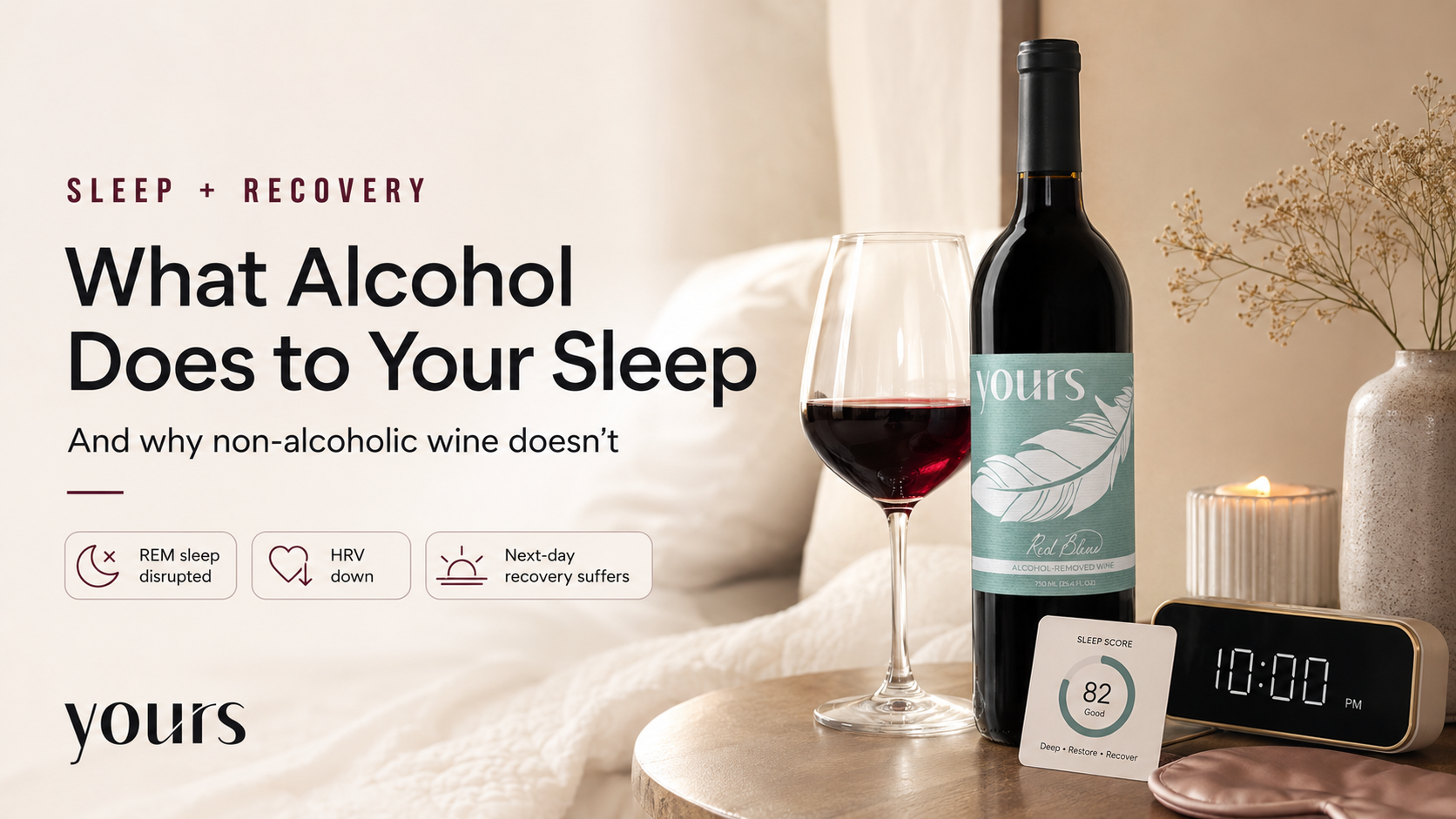
You think the glass of wine at dinner helps you sleep. You fall asleep faster, feel drowsy by 10pm, maybe even sleep through the night. But your Oura ring says something different. Your HRV is down. Your recovery score is tanked. You feel like you slept eight hours and woke up behind.
That gap between how you feel going to sleep and how you feel waking up is not a coincidence. Alcohol changes your sleep architecture in ways that feel helpful at first and cost you everything in the second half of the night. This is what is actually happening, explained with the same precision you would apply to any other input that affects your performance.
This article covers what alcohol does to REM sleep, what it does to your wearable data, and what YOURS non-alcoholic wine does instead. Short answer: nothing. And that is the point.

How Even One Drink Disrupts Your REM Sleep Cycle
Alcohol is sedating. That part is real. It activates GABA receptors, slows neural activity, and pulls you into slow-wave (deep) sleep faster than a sober night would. This is why people swear it helps them sleep. The first half of the night genuinely looks better.
The problem is what happens next. A 2018 study published in JMIR Mental Health found that alcohol intake disrupts cardiovascular autonomic regulation during sleep in a dose-dependent manner, low, moderate, and high doses each producing progressively worse recovery outcomes, measured across 12,411 sleep recordings from 4,098 subjects. Even at low doses, measurable disruption was recorded.
The mechanism is REM suppression in the first half of sleep followed by REM rebound in the second half (Roehrs & Roth, Alcohol Research & Health, 2001). Your body treats alcohol as a toxin, processes it across the night, and as blood alcohol concentration drops, the brain overcorrects. REM pressure surges in the early morning hours, fragmenting sleep during the window when memory consolidation and emotional processing are supposed to happen.
One to two drinks is enough. The suppression is not dose-linear at the low end. Even a single standard drink has a measurable effect on REM architecture in people with regular sleep tracking.
What Your Wearable Is Actually Measuring When You Drink
If you use Whoop, Oura, or Garmin, you have seen the alcohol flag in your recovery data. It is not algorithmic theater. Those devices track heart rate variability because HRV is a direct signal of autonomic nervous system recovery. Alcohol drops HRV measurably after even one to two drinks.
Whoop's internal data shows that alcohol is one of the most reliably detectable inputs in HRV suppression, often flagged even when users do not self-report a drink. The device is reading the physiological reality your subjective experience is masking.
There are two other mechanisms at work. Alcohol is a diuretic. It suppresses ADH (antidiuretic hormone), which means your kidneys produce more urine overnight. Even low-dose consumption increases the probability of nighttime waking to urinate, fragmenting sleep architecture directly. Second, alcohol raises core body temperature. The natural temperature drop required to initiate and sustain deep sleep is disrupted. Your body cannot cool the way it needs to, and sleep quality degrades as a result. These are not contested findings. They are basic physiology measured in controlled settings.
The Weeknight Math: What Cumulative Drinking Actually Costs You
Individual nights are easy to rationalize. The math changes when you zoom out. If you have two glasses of wine with dinner on Monday, Wednesday, and Friday, you are suppressing REM sleep on six half-nights per week. The REM rebound on those nights means fragmented early morning sleep. Over a week, you are losing hours of the restorative sleep that consolidates what you learned, processed, and trained.
The cognitive budget matters here. REM sleep is where the prefrontal cortex gets rebuilt for the next day. Emotional regulation, decision quality, pattern recognition, retention. All of it depends on adequate REM. Research has documented that REM sleep deprivation produced by even moderate alcohol consumption is indistinguishable in its cognitive effects from acute partial sleep deprivation (Roehrs & Roth, Alcohol Research & Health, 2001).
A 2018 JMIR Mental Health study found that alcohol's disruption to autonomic recovery during sleep compounds across consecutive nights. The body does not adapt to the disruption. It accrues a debt.
 What YOURS Does to Your Sleep: Nothing, and That Is the Data Point
YOURS is dealcoholized California wine at 0.5% ABV or less. There is no alcohol load for your liver to process overnight. No ADH suppression. No diuretic pressure. No core temperature spike. No REM suppression in the first half and no REM rebound in the second half.
The glass looks the same. The ritual looks the same. If you have been reading about why YOURS tastes dry when most NA wine tastes sweet, you already know the flavor engineering behind it. But the performance case is separate and simpler: zero alcohol input produces zero alcohol-driven sleep disruption.
YOURS is under 20 calories per glass, 4g of carbs, zero added sugar, and monk fruit sweetened. It was developed over two years with California winemakers who were trying to solve the flavor problem, not just remove the alcohol from something mediocre. The result is a wine that fits the same dinner slot, the same decompression ritual, the same social context, without writing a check against your recovery your sleep will have to cash at 3am.
You can also explore the full YOURS collection if you want to see what the actual product options are.
 Why 92% of Buyers Are Not Quitting Wine. They Are Rotating.
YOURS is not positioned for people who have sworn off alcohol. 92% of non-alcoholic wine buyers still drink alcohol (NIQ, 2024). They are moderators, not people taking a break. Circana data from 2025 shows that 49% of Americans are actively trying to drink less, not stop entirely.
The use case is exactly what it sounds like. Wednesday night when you have a 6am workout. The weeknight where you want to decompress with something in a glass but you are not willing to trade the next day's output for it. The dinner where you want to match the ritual without absorbing the cost. That is the rotation.
The science does not require abstinence to support this. Even reducing alcohol nights from five to two per week significantly reduces cumulative REM suppression over a month. The math works in partial increments. The point is not purity. It is precision about what you are trading and when you are willing to trade it.
If you're navigating Dry January and want to keep the dinner ritual intact, read Non-Alcoholic Wine for Dry January. For the full nutritional breakdown, including calories, carbs, and why the sweetener matters, see The Lowest Calorie Non-Alcoholic Wine. If alcohol's hormonal effects, including how they interact with perimenopause and menopause, are relevant to you, see Alcohol and Menopause. For the separate question of wine headaches and why most of them have nothing to do with sulfites, see Does Non-Alcoholic Wine Give You Headaches?. For the downstream effects on training and recovery, what alcohol costs you in the gym and on the track, see What Alcohol Does to Athletic Performance.
Frequently Asked Questions
Does alcohol actually ruin your sleep?
Yes. Alcohol restructures sleep architecture by suppressing REM sleep in the first half of the night and causing REM rebound in the second half, producing fragmented, unrestorative sleep. A 2018 study in JMIR Mental Health found that even low doses produce measurable disruption to autonomic recovery during sleep, with disruption increasing dose-dependently through moderate and high consumption. The effect occurs even when subjective feelings of sleep quality are positive.
Does non-alcoholic wine affect sleep?
Non-alcoholic wine with 0.5% ABV or less does not contain enough alcohol to trigger the physiological mechanisms that disrupt sleep. There is no meaningful ADH suppression, no HRV impact, and no REM suppression at trace alcohol levels found in dealcoholized wine. The sleep disruption associated with wine is driven by the alcohol, not the wine itself.
How many drinks does it take to disrupt REM sleep?
One to two standard drinks is sufficient to produce measurable REM suppression, as documented in peer-reviewed sleep research (Roehrs & Roth, Alcohol Research & Health, 2001). The effect is not exclusively dose-dependent at low levels. A single drink consumed in the four hours before sleep produces detectable changes in sleep architecture in monitored subjects.
Is non-alcoholic wine good for you?
Non-alcoholic wine eliminates the primary health costs of regular wine: the alcohol load, the calorie density, and the sleep disruption. YOURS specifically comes in at under 20 calories per glass, 4g carbs, and zero added sugar. Whether it carries the polyphenol benefits of regular wine depends on the dealcoholization method and grape variety. The documented downside removal, however, is unambiguous.
Does non-alcoholic wine have the same health benefits as regular wine?
The often-cited cardiovascular benefits of red wine are attributed to polyphenols like resveratrol, which are present in the grape regardless of alcohol content. Dealcoholized wine retains some of these compounds depending on the process used. What it does not retain is the sedative that suppresses REM sleep, raises core temperature, and drops HRV. The claimed benefits of regular wine remain scientifically contested. The sleep disruption caused by its alcohol content is not.
What is the best drink to have with dinner if you want good sleep?
A dealcoholized wine, herbal tea, or sparkling water with no alcohol is the best choice for sleep quality. Alcohol consumed with dinner, even two to three hours before bed, is still being metabolized during sleep, which means ADH suppression and REM disruption are still occurring in the early morning hours. The closer to bedtime, the more severe the effect. A zero-alcohol alternative consumed during the same ritual produces no measurable sleep disruption.
If you're in a period of drinking less and want to keep the dinner ritual intact, read Drinking Less Without Making It a Thing. For the full category comparison on what to buy, see The Best Non-Alcoholic Wine: An Honest Buyer's Guide.
Frequently Asked Questions
Does alcohol actually ruin your sleep?
Yes. Alcohol restructures sleep architecture by suppressing REM sleep in the first half of the night and causing REM rebound in the second half, producing fragmented, unrestorative sleep. A 2018 study in JMIR Mental Health found that even low doses produce measurable disruption to autonomic recovery during sleep, with disruption increasing dose-dependently through moderate and high consumption. The effect occurs even when subjective feelings of sleep quality are positive.
Does non-alcoholic wine affect sleep?
Non-alcoholic wine with 0.5% ABV or less does not contain enough alcohol to trigger the physiological mechanisms that disrupt sleep. There is no meaningful ADH suppression, no HRV impact, and no REM suppression at trace alcohol levels found in dealcoholized wine. The sleep disruption associated with wine is driven by the alcohol, not the wine itself.
How many drinks does it take to disrupt REM sleep?
One to two standard drinks is sufficient to produce measurable REM suppression, as documented in peer-reviewed sleep research (Roehrs & Roth, Alcohol Research & Health, 2001). The effect is not exclusively dose-dependent at low levels. A single drink consumed in the four hours before sleep produces detectable changes in sleep architecture in monitored subjects.
Is non-alcoholic wine good for you?
Non-alcoholic wine eliminates the primary health costs of regular wine: the alcohol load, the calorie density, and the sleep disruption. YOURS specifically comes in at under 20 calories per glass, 4g carbs, and zero added sugar. Whether it carries the polyphenol benefits of regular wine depends on the dealcoholization method and grape variety. The documented downside removal, however, is unambiguous.
Does non-alcoholic wine have the same health benefits as regular wine?
The often-cited cardiovascular benefits of red wine are attributed to polyphenols like resveratrol, which are present in the grape regardless of alcohol content. Dealcoholized wine retains some of these compounds depending on the process used. What it does not retain is the sedative that suppresses REM sleep, raises core temperature, and drops HRV. The claimed benefits of regular wine remain scientifically contested. The sleep disruption caused by its alcohol content is not.
What is the best drink to have with dinner if you want good sleep?
A dealcoholized wine, herbal tea, or sparkling water with no alcohol is the best choice for sleep quality. Alcohol consumed with dinner, even two to three hours before bed, is still being metabolized during sleep, which means ADH suppression and REM disruption are still occurring in the early morning hours. The closer to bedtime, the more severe the effect. A zero-alcohol alternative consumed during the same ritual produces no measurable sleep disruption.
Related in this topic
- Non-Alcoholic Wine Health Guide (topic guide)
- Non-Alcoholic Wine for Weight Management: How a Glass a Day Can Help You Lose Weight
- The Lowest Calorie Non-Alcoholic Wine (With Real Numbers)
- Non-Alcoholic Wine for Dry January: A Guide for People Who Actually Like Wine
- Hangxiety: Why Alcohol Makes You Anxious the Next Morning (And What the Biology Actually Says)