Drinking Less Without Making It a Thing
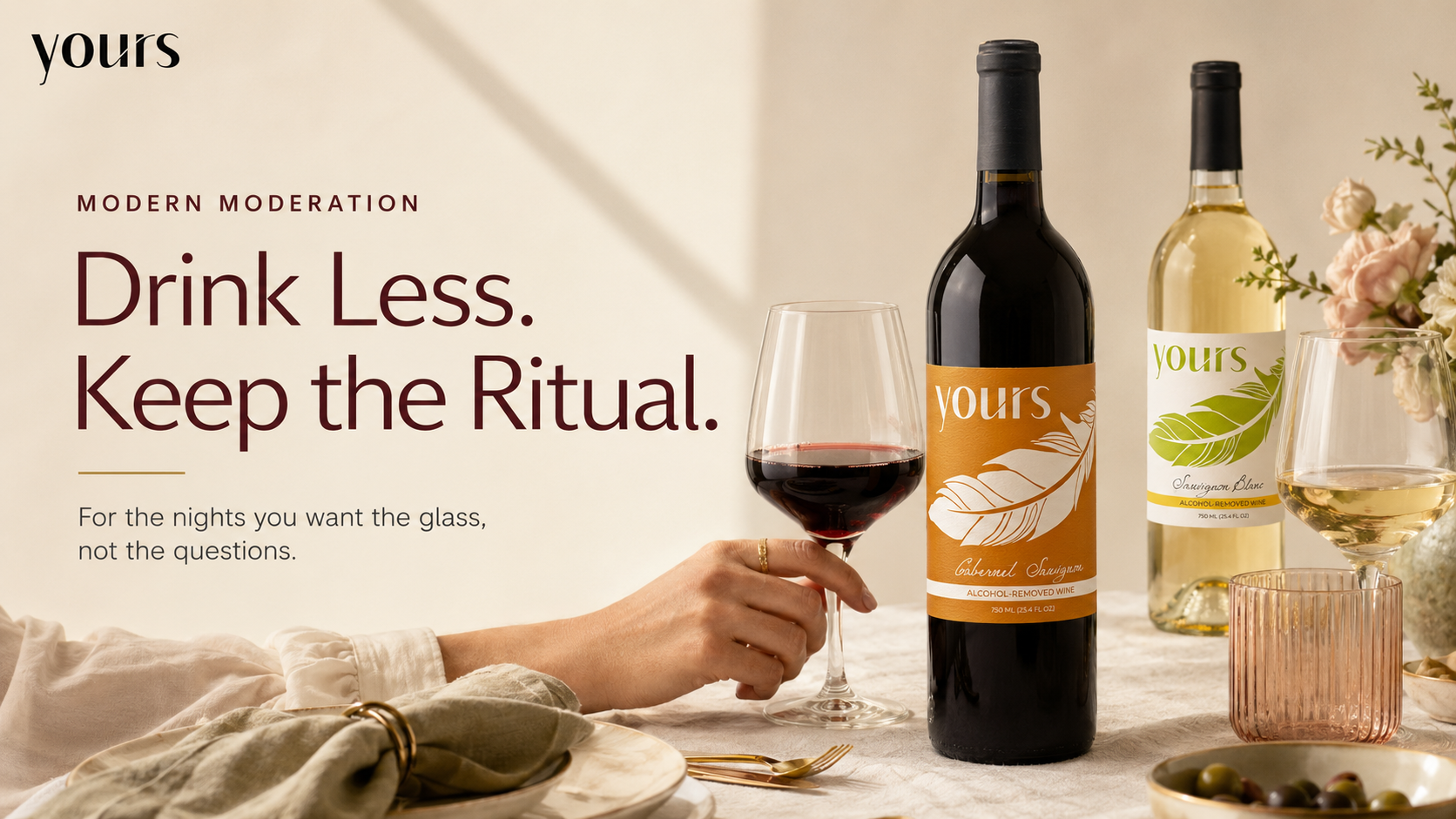
You're at dinner. Everyone orders a second glass and the bottle passes to you. You don't really want it. You have an early morning, you didn't sleep well last week, or you just feel better when you stop at one.
So you say no.
And then the questions start. "Are you driving?" "Are you okay?" "Are you doing Dry January?" Suddenly a quiet personal decision becomes a whole conversation you didn't ask for.
This is the part nobody writes about. Not the choosing to drink less. The explaining yourself. The feeling that without a reason people will understand, you'll seem weird, or difficult, or like you're making a statement.
Most people who are drinking less right now aren't making a statement. They're just choosing differently on a given night. No label. No movement. No announcement required.
YOURS Non-Alcoholic Wine exists for exactly that moment. The pour is the same. The glass is the same. The ritual holds. The conversation moves on.
Why Half of America Is Quietly Drinking Less Right Now
The shift is happening at scale, and most people doing it haven't told anyone.
49% of Americans actively tried to reduce their alcohol consumption in 2025, according to Circana (Circana US Beverage Alcohol Report, 2025). That is not a fringe group. That is roughly half the country making a personal calculation about how often and how much they drink.
And the important detail: 92% of non-alcoholic wine buyers still also purchase regular alcoholic wine (NIQ Off-Premise NA Beverage Report, 2024). Over 93% of NA beverage buyers overall continue to buy traditional alcoholic drinks, per the same NIQ dataset. These are not people who have quit. They are people managing their intake on their own terms, some nights choosing one thing, some nights choosing another.
The US non-alcoholic beverage category hit $925 million in US off-premise sales in 2024, a 22% year-over-year increase, according to NIQ (NIQ Off-Premise NA Beverage Report, 2024). That growth is not coming from people taking a break. It's coming from people who want optionality. Wine some nights. Non-alcoholic wine other nights. No drama either way.
Nobody organized this. There's no meeting, no pledge, no community. There's just a lot of people making a quiet calculation and a market responding to it.
The Real Reasons People Are Cutting Back (It's Not About Sobriety)
The shift isn't about sobriety. Per NIQ 2024 data:
- 52% say they're drinking less to improve sleep
- 48% cite overall health and energy levels
- 34% mention weight management
- 29% say they simply enjoy it less than they used to
- 92% of NA wine buyers still drink alcohol occasionally, they're moderating, not quitting
The dominant motivation is optimization, not abstinence. (NIQ 2024 Non-Alcoholic Beverage Consumer Survey)
Why the "drinking less" Framing Often Makes Things Harder
"drinking less" is a real cultural phenomenon, and it has done something genuinely useful: it made it more acceptable to question your drinking without requiring a dramatic reason.
But it also, somewhat accidentally, created another label. Another identity to explain. Another thing to announce at dinner.
The people who actually fit the behavior don't necessarily fit the label. They're not curious about sobriety. They're not exploring an identity. They had one drink instead of three last Tuesday because they had an early meeting Wednesday. That's it. That's the whole story.
The label puts pressure on the decision in a way that makes it bigger than it needs to be. When you say "I'm drinking less," people want to know why. They want to support you, ask questions, make it a thing. Which is kind, but it's the opposite of what most people in this situation actually want.
What most people want is to order something that looks like wine, tastes like wine, and allows the table to move on.
The mismatch between the cultural conversation around moderation and what moderators actually want in the moment is real. YOURS was built for the moment, not the movement.

What the Ritual Actually Provides (and Why It Matters)
If you drink wine regularly, the drink is not just the alcohol. It's the pause. The pour. The visual of a glass on a table that signals the day is done.
There's actual psychology behind this. The ritual marks a transition. From work to evening. From effort to rest. From the public version of yourself to the private one. Behavioral research on habit cue-routine-reward loops, including work by Charles Duhigg summarizing neuroscience from MIT and elsewhere, identifies environmental and sensory cues as the primary triggers for habitual behavior. The act of uncorking something, filling a glass, holding it while you talk signals belonging, relaxation, and participation in a way that a glass of water simply does not. The cue is the ritual, not the substance.
When you cut back on alcohol by swapping to sparkling water, you lose the ritual. You're still at the table but slightly outside the moment. The glass says something different.
Non-alcoholic wine that's actually made from real wine preserves all of that. YOURS starts as California-grown grapes, made by California winemakers using the same process as conventional wine. The alcohol is removed at the end, through a process designed to preserve the phenols, tannins, and flavor compounds that make wine taste like wine. The full explanation of how non-alcoholic wine is made is worth reading if you want to understand why the production approach matters.
The Cabernet Sauvignon has the dry finish and dark fruit of a wine you'd actually want at dinner. The Sauvignon Blanc has the brightness you'd expect from Washington grapes. The Rosé sits where a good rosé should. None of them are sweet, because monk fruit handles the sweetness and the sugar is zero grams added. See our YOURS wine review for tasting notes across all four varieties.
The glass looks right. The ritual holds. And the table conversation moves on.
How to Use NA Wine as a Practical Moderation Tool
The most common use case is simpler than people make it sound: keep a bottle in the fridge and reach for it on nights when you want the experience without the aftermath.
Some practical setups that work:
Alternating glasses at dinner. One glass of wine, one glass of YOURS. The ritual continues for the whole meal. You wake up clear. This is the most smooth approach because nothing about the evening changes for anyone around you.
YOURS nutrition varies by wine and serving size. Red Blend has 10 calories, 2g carbs, and 1g total sugar per 5 oz. Chardonnay has 30 calories, 7g carbs, and 4g total sugar per 5 oz. Washington Sauvignon Blanc has 17 calories, 2g carbs, and 1g total sugar per 3.4 oz. These wines have no added sugar and contain less than 0.5% ABV. Read the product-specific nutrition table.
Hosting. Put YOURS on the table alongside whatever else you're serving. Guests who want it will reach for it. You don't have to explain, announce, or call attention to it. It's just another bottle.
The transition drink. Some people use it as the first glass of the evening and then decide from there whether they want to open something alcoholic. The ritual is satisfied. The default has shifted.
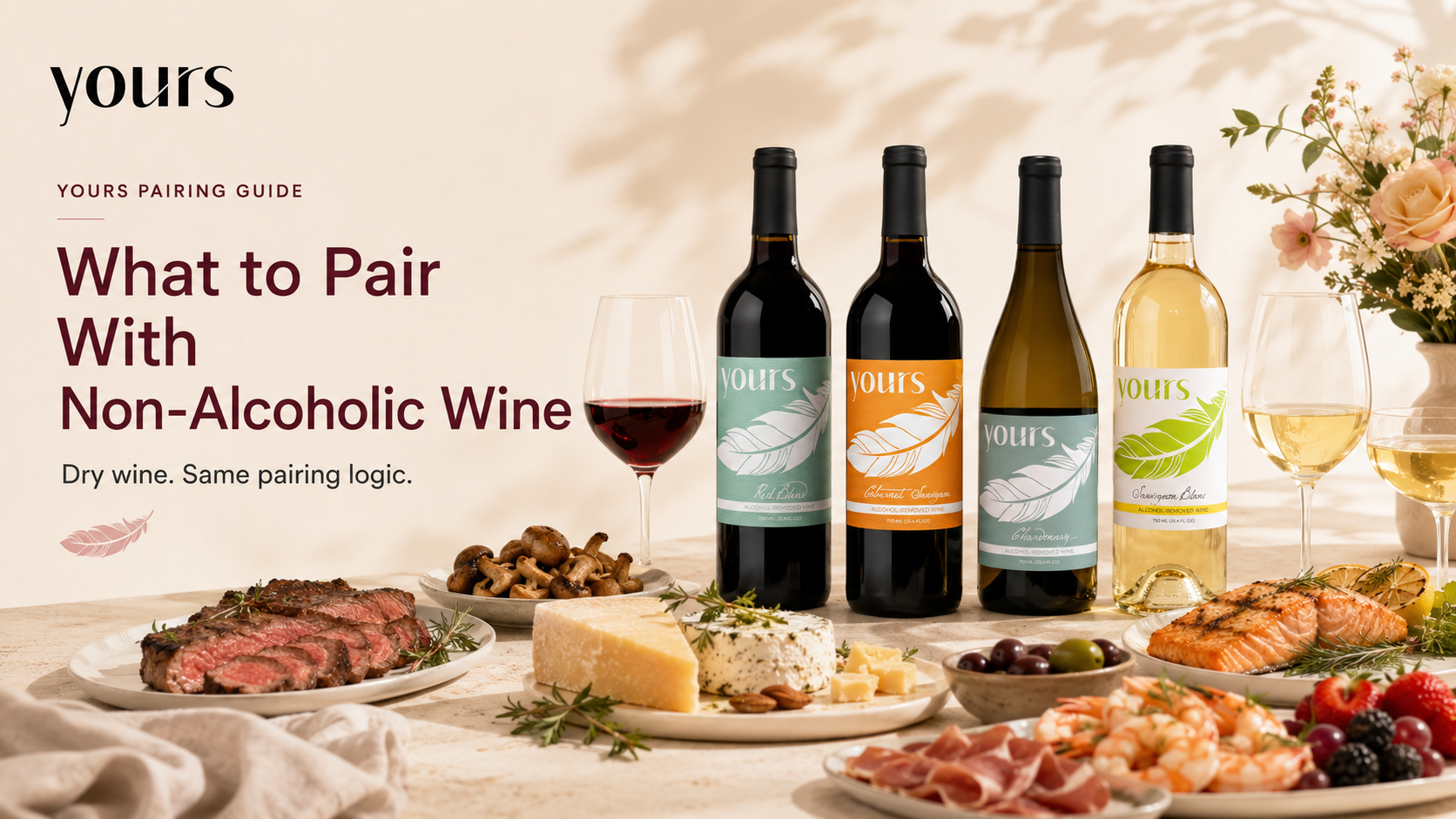
YOURS comes in four bottles: California Cabernet Sauvignon, Washington Sauvignon Blanc, Rosé, and California Red Blend. Each one was developed by California winemakers specifically to be dry and to finish the way wine should. For where to buy and what to expect from each retailer, the where to buy non-alcoholic wine guide has the full breakdown.
For pairing guidance, the non-alcoholic wine food pairing guide covers what works well with each varietal.
The Conversation You Don't Have to Have
Here is the thing: you do not owe anyone an explanation.
"I'm driving" works. "Taking a break" works. Pouring from a different bottle and moving on works just as well. Most people at a dinner table are more focused on their own glass than yours.
The pressure to explain moderation is largely self-generated. The social norm is shifting faster than most people realize. Per Circana's 2025 data, 49% of Americans are actively trying to reduce alcohol consumption, which means statistically, at least one other person at most dinner tables is doing the same thing. The friend who would've pushed you to drink more in 2018 probably isn't doing that in 2026 because they've recalibrated too.
And with YOURS, you frequently don't face the question at all. The bottle on the table looks like wine. What's in your glass looks like wine. Nobody has to know it isn't, and if they ask, the answer is simple: "It's non-alcoholic. It's actually really good."
No performance. No movement membership. No explanation required.
For the nights you're asked whether to reach for something alcoholic at all, the sleep piece on what alcohol does overnight is worth reading. The data there is straightforward and it reframes the tradeoff clearly. If hormonal shifts, perimenopause, menopause, are part of why you're cutting back, see Alcohol and Menopause for the full picture on how alcohol interacts with that biology. If you're gifting to a dad who is also cutting back or simply wants better mornings, the non-alcoholic wine Father's Day guide has context and gift framing for that occasion.
Frequently Asked Questions
What does it mean to be drinking less?
"drinking less" refers to a cultural movement and mindset of questioning your drinking habits without committing to full abstinence. It emerged in the late 2010s as a way to describe people who were reducing alcohol for lifestyle reasons rather than addiction or health crisis. It's useful as a cultural frame, but many people actively reducing their drinking don't identify with the label at all.
How do you cut back on alcohol without quitting entirely?
The most sustainable approach is substitution rather than elimination: replace some drinks with something that preserves the ritual. Keeping a bottle of non-alcoholic wine alongside regular wine lets you make a choice in the moment without breaking the social or sensory experience. Alternating between alcoholic and non-alcoholic glasses during a meal is a practical starting point that requires zero announcement or explanation.
Is non-alcoholic wine a good substitute for regular wine when drinking less?
For ritual preservation, yes. Quality matters significantly here. Non-alcoholic wines made from real wine through dealcoholization retain the flavor compounds, tannins, and dry finish that make wine feel like wine. Products that aren't wine-based, or that compensate with sugar, fall flat. YOURS is made from California and Washington wine grapes by California winemakers, dealcoholized and sweetened with monk fruit, with zero added sugar, which keeps the dry profile intact.
What do you drink at a dinner party when you're not drinking alcohol?
Non-alcoholic wine is the option that integrates most smoothly because the glass looks identical and the ritual is the same. Sparkling water with citrus works but signals something different to the table. YOURS Cabernet or Red Blend works with most dinner party food contexts; the Sauvignon Blanc and Rosé work earlier in the evening or with lighter dishes. You can find pairing specifics in the YOURS food pairing guide.
Does drinking less alcohol actually improve your health?
Check the current YOURS nutrition table for the exact wine and serving size. Calories, carbohydrates, and total sugar differ by bottle.
How do you politely decline a drink without explaining yourself?
"I'm good with this, thanks" while holding a glass is the cleanest option, and it's essentially invisible if what's in your glass looks like wine. Otherwise, "driving," "early morning," or "taking it easy tonight" are all complete sentences that require no follow-up. The social expectation to explain a drink refusal has loosened considerably. Most people accept a brief answer and move on. The explanation pressure is usually larger in anticipation than in practice.
Frequently Asked Questions
What does it mean to be sober curious?
Sober curious refers to a cultural movement and mindset of questioning your drinking habits without committing to full abstinence. It emerged in the late 2010s as a way to describe people who were reducing alcohol for lifestyle reasons rather than addiction or health crisis. It's useful as a cultural frame, but many people actively reducing their drinking don't identify with the label at all.
How do you cut back on alcohol without quitting entirely?
The most sustainable approach is substitution rather than elimination: replace some drinks with something that preserves the ritual. Keeping a bottle of non-alcoholic wine alongside regular wine lets you make a choice in the moment without breaking the social or sensory experience. Alternating between alcoholic and non-alcoholic glasses during a meal is a practical starting point that requires zero announcement or explanation.
Is non-alcoholic wine a good substitute for regular wine when drinking less?
For ritual preservation, yes. Quality matters significantly here. Non-alcoholic wines made from real wine through dealcoholization retain the flavor compounds, tannins, and dry finish that make wine feel like wine. Products that aren't wine-based, or that compensate with sugar, fall flat. YOURS is made from California and Washington wine grapes by California winemakers, dealcoholized and sweetened with monk fruit, with zero added sugar, which keeps the dry profile intact.
What do you drink at a dinner party when you're not drinking alcohol?
Non-alcoholic wine is the option that integrates most seamlessly because the glass looks identical and the ritual is the same. Sparkling water with citrus works but signals something different to the table. YOURS Cabernet or Red Blend works with most dinner party food contexts; the Sauvignon Blanc and Rosé work earlier in the evening or with lighter dishes.
Does drinking less alcohol actually improve your health?
Yes, across several measurable dimensions. Sleep quality improves meaningfully when alcohol is removed, even at low consumption levels, because alcohol suppresses REM sleep regardless of amount. Calorie reduction is significant: a standard glass of wine is 120-130 calories versus under 20 for YOURS Non-Alcoholic Wine. Hangovers, however mild, carry a productivity and mood cost most people undercount until they stop experiencing them.
How do you politely decline a drink without explaining yourself?
Holding a glass that looks like wine eliminates the question most of the time. Otherwise, brief answers like 'driving,' 'early morning,' or 'taking it easy tonight' are complete sentences that require no follow-up. The social expectation to explain a drink refusal has loosened considerably, and the explanation pressure is usually larger in anticipation than in practice.