How to Store Non-Alcoholic Wine Before and After Opening
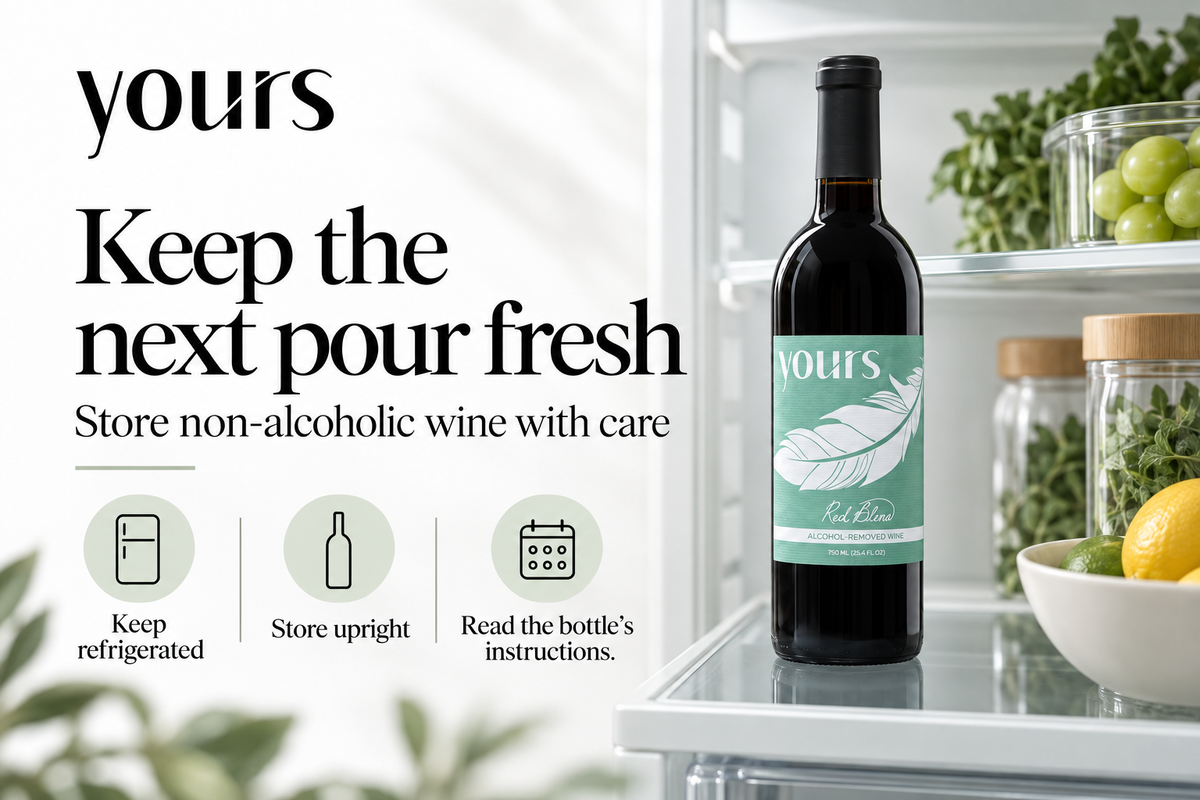
Store unopened non-alcoholic wine as its producer directs. After opening, reseal it, refrigerate it, and follow the exact bottle's storage window. A serving temperature and a storage instruction are different things. Red wine may be served warmer than the refrigerator, but that does not mean an opened bottle belongs on the counter.
The simplest habit is to keep the label, note the opening date, and put the remaining wine away after pouring. This YOURS guide explains the decisions to make before opening, after opening, and before serving again. Sources and product details were checked on September 12, 2026.
Before opening: check the bottle and its instructions

Read any storage directions and date information on the bottle or packaging. Choose a place away from direct sun and avoid leaving a delivery in a hot location. If the producer says the unopened product must be refrigerated, follow that instruction from the start.
| Check | What to look for | What to do |
|---|---|---|
| Storage directions | Refrigeration or cool-storage requirements | Use the stated conditions |
| Date information | Best-before, use-by, or other producer guidance | Keep the date with the bottle |
| Closure | An intact cap, cork, or seal | Contact the seller if it arrives damaged |
| Delivery condition | Leaks or unexpected damage | Resolve the issue before opening |
Keep bottles where you can read their labels. A decorative cellar arrangement should not make the date or product identity hard to find. You can organize by planned meal or occasion, with the bottles you intend to use first easiest to reach.
For YOURS order or bottle questions, use our contact page. Provide the product name and any batch details on the package. A seller can give a more useful answer when it knows which bottle you have.
After opening: reseal, refrigerate, and note the date

Pour the amount you plan to serve, close the bottle properly, and return the remaining wine to the refrigerator. A note with the opening date prevents guesswork later. Keep the original label accessible.
For still wine, use its clean original closure or a suitable stopper. For sparkling wine, use a stopper designed for sparkling bottles and follow that producer's directions. A closure helps you store the product as intended; it does not extend a stated storage window automatically.
Serving instructions have a different purpose. A producer may suggest taking red wine out briefly before serving to reach a preferred temperature. That is a preparation step, not a reason to store the opened bottle warm. Our serving-temperature guide covers the serving decision.
Avoid opening several bottles just to display the full selection. Bring out another when guests need it. This reduces the number of partly used bottles to manage after the meal.
How long does non-alcoholic wine last after opening?

There is no single storage window for every non-alcoholic wine. The producer's instructions apply to its own product. Formulation, packaging, and storage conditions can differ, so a day count from one brand should not be copied onto another.
For example, the current FRE Merlot page recommends refrigeration after opening and use within one to two days for best flavor. That is a specific producer's flavor guidance, not a universal safety rule or a YOURS instruction.
If you cannot find guidance for your exact YOURS bottle, contact us with the product name and label details. This article does not invent a fixed shelf life for the range. The bottle and the producer's current instructions should guide the decision.
A date on an unopened bottle also does not necessarily describe how long it will last once opened. Keep those two questions separate. If the bottle was stored outside its required conditions, ask the producer rather than resetting the clock when it goes back into the refrigerator.
Before the next pour: make a clear decision

Check the opening date and the storage directions before serving again. If the closure has failed, the bottle leaked, or the contents have changed unexpectedly, do not rely on a taste test to prove safety. Seek product-specific guidance or discard a doubtful bottle.
Keep quality and safety questions separate. A wine may lose the flavor you enjoy, and a normal appearance or smell cannot certify that an incorrectly stored food or drink is safe. Avoid treating a general blog as a laboratory test of the bottle in your kitchen.
For your next order, choose a quantity that fits how you serve wine. A mixed box can help you compare the current range, but open bottles as needed. Start with the YOURS collection, then use our pairing guide to plan the meals each bottle will accompany.
YOURS wines contain less than 0.5% ABV. Alcohol content is one label fact; it is not a substitute for storage instructions. For terminology, read the label guide.
Frequently asked questions
Should opened non-alcoholic red wine go in the refrigerator?
Reseal and refrigerate it according to its producer's directions. A warmer serving preference does not change the need to follow opened-bottle storage guidance.
Does unopened non-alcoholic wine expire?
Use the date and storage guidance for the exact product. Do not assume every non-alcoholic wine is made for long-term aging.
Can I use one brand's three-day or five-day rule for another?
No. Follow the bottle's own instructions or ask its producer. A general day count does not establish the life of a different product.
Does a vacuum stopper guarantee a longer life?
Follow the producer's instructions even when using a stopper. An accessory does not automatically replace the product's storage window.
What information should I send with a storage question?
Give the product name, label or batch details, when you opened it, and how it has been stored. Include any visible damage or unusual change.