The Best Non-Alcoholic Red Wine: Why Most Fail and What to Look For
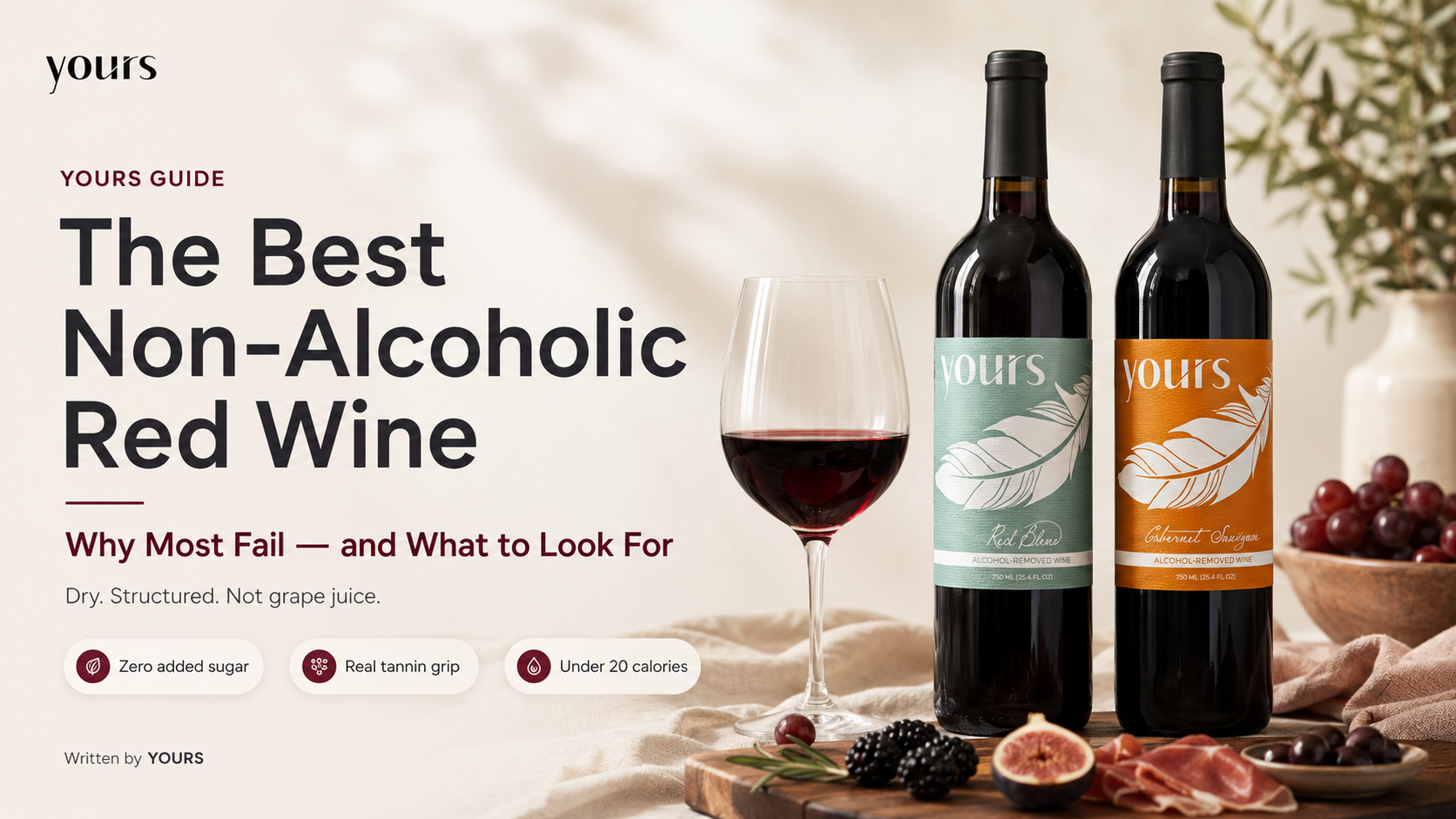
Most non-alcoholic red wines taste like grape juice with a wine label. That is not an accident. It is the predictable result of a production shortcut that almost every brand in the category takes.
The best non-alcoholic red wines in 2026 are: YOURS California Cabernet Sauvignon, YOURS California Red Blend, Zeronimo Leonis Blend (if budget is not a concern), and Saint Viviana Cabernet Sauvignon (for a budget-conscious option that actually has tannins). Below is an honest breakdown of each, including the technical reason most NA reds fail the people who try them.
Why Non-Alcoholic Red Wine Almost Always Disappoints
We were these people. Bottle after bottle, hopeful pour after hopeful pour, and the same result: sweet, thin, nothing like a red wine.
The disappointment is earned. The category has a real technical problem, and most producers have not solved it.
When a winemaker removes alcohol from wine, approximately 13 to 15 percent of the total liquid volume leaves with it. That volume needs to be replaced. Most producers replace it with grape juice concentrate. It is cheap, easy to source, and fills the bottle back up. The cost is 8 to 12 grams of added sugar per glass and a sweet, syrupy profile that collapses everything a red wine is supposed to deliver.
The tannin collapse is the specific failure no one explains clearly. Tannins are structurally dependent on the ethanol and glycerol matrix in wine. When alcohol is removed without careful reconstruction, that matrix falls apart. Tannin perception drops. The drying, gripping sensation on the palate disappears. What remains feels watery and flat, with none of the structure that separates a red wine from a red juice.
The aroma problem runs in parallel. Research published in 2025 found ester losses of up to 96 percent under full vacuum distillation during dealcoholization (Akhtar et al., "Dealcoholized wine: Techniques, sensory impacts, stability, and perspectives," PMC12004437, 2025). This is why many non-alcoholic reds smell thin even before you taste them. The volatile aromatic compounds that carry the scent of wine are stripped out alongside the ethanol.
Sugar patches over some of these problems. It adds perceived body. It makes the wine smell sweeter, which the brain sometimes reads as fruit complexity. But sugar does not restore tannins. It does not restore a dry finish. It does not make the wine taste like a red.
This is the specific failure mode the category has been stuck in for decades. White wines can be made credibly without alcohol because their defining characteristics, acidity and fresh fruit, survive dealcoholization reasonably well. Red wines are harder. The things that make them red wines, tannins, body, structure, dry finish, are exactly the things the process destroys.
For a deeper technical breakdown of why this happens, read how non-alcoholic wine is made. For the full picture on what happens to polyphenols, resveratrol, and antioxidants during the process, read Polyphenols in Non-Alcoholic Wine.
What "Good" Actually Means for a Non-Alcoholic Red
Before buying anything, it helps to know what you are evaluating.
A red wine is defined by four things: dryness, tannin structure, body, and finish. A good non-alcoholic red should deliver all four, or come close enough that you are not constantly aware of what is missing.
Dryness means no perceptible residual sweetness. A standard dry red wine contains under 4 grams of residual sugar per serving. Most non-alcoholic reds contain 8 to 20 grams due to added concentrate. The TTB defines non-alcoholic wine as containing 0.5 percent ABV or less, but ABV says nothing about sugar content. Always check the label.
Tannin structure is the gripping, mouth-coating, slightly drying sensation that red wine delivers on the palate. It is what makes a Cabernet feel like something. Most NA reds have very low tannin levels because dealcoholization does not preserve the ethanol-tannin matrix. A wine described as "full-bodied" on the label and paper-thin in the glass failed here.
Body is the weight and viscosity of the liquid. Alcohol contributes significantly to body in wine. Without careful rebuilding, NA reds feel like water dressed up as wine. Body is what lets a red wine pair with steak.
Finish is what happens after you swallow. A real dry red has a finish that lasts and trails off dry. A sweet or thin NA red has no finish. It ends the moment it leaves your mouth.
Knowing these four markers tells you immediately whether the bottle you are considering has actually solved the problem or just renamed it.
For a deeper look at why most NA reds trend sweet even when they do not advertise it, read why most non-alcoholic wines taste sweet and why YOURS doesn't. For the full breakdown of tannins specifically, what they are, why dealcoholization preserves them but concentrate destroys them, and how to feel for them in the glass, read Tannins in Non-Alcoholic Wine.
The Best Non-Alcoholic Red Wines: An Honest Comparison
| Wine | Style | Cal/5oz | Added Sugar | Tannin Level | Price |
|---|---|---|---|---|---|
| YOURS California Red Blend | Dry, full-bodied | 10-20 | None | Medium-high | ~$18-22 |
| YOURS California Cabernet | Dry, structured | 10-20 | None | High | ~$18-22 |
| Zeronimo Leonis Blend (Austria) | Dry, complex | N/A | None stated | High | $72.40 |
| Saint Viviana Cabernet (CA) | Dry, tannin-rich | ~6-10 | 1g added sugar | Medium-high | $22.99 |
| Giesen 0% Merlot | Semi-sweet | 25-35 | Minimal | Low | ~$12-16 |
| Surely Non-Alcoholic Red Blend | Thin, light | 20-30 | Minimal | Very low | ~$14-18 |
| Ariel Cabernet Sauvignon | Semi-sweet | ~30 | Yes (concentrate) | Low | ~$8-12 |
Prices approximate as of 2025. Confirm at retailer before purchase. Calorie and nutrition data per brand label data or published brand information. Zeronimo and Saint Viviana data per brand specifications.
YOURS California Red Blend
This is the entry point for the category if you have been disappointed before.
The Red Blend leads with black currant and ripe dark fruit, followed by cedar, vanilla, and oak on the mid-palate. The finish is dry. Not the hollow dry of something that simply has no sugar. The structured dry of a wine that was built to finish correctly. You notice tannin grip. You notice body. These are not things that occur naturally in most NA wines.
YOURS spent two years in development specifically on the mouthfeel problem. Instead of filling the volume lost during dealcoholization with grape juice concentrate or glycerin, they use a curated blend of natural ingredients engineered to restore texture and body. Monk fruit provides sweetness perception without added sugar and without syrupy texture. The result: zero added sugar, 4g carbohydrates per glass, under 20 calories (per YOURS product labels).
The flavor profile works on food. Grilled vegetables, pasta with tomato-based sauces, charcuterie, aged cheese. The tannin structure is what makes these pairings hold together. A sweet NA red overwhelms food. YOURS Red Blend sits alongside it.
Made by California winemakers from real wine grapes. Dealcoholized to 0.5 percent ABV or less. Nothing added that compromises the dry wine experience.
For a detailed pairing guide, read non-alcoholic wine food pairing.
YOURS California Cabernet Sauvignon
If you drink Cabernet specifically because you want dark fruit, structure, and a serious dry finish, this is the bottle.
The Cabernet leads with dark fruit, black currant, and ripe plum. Behind it: tobacco, cedar, oak. These are varietal markers, not additions. They were in the wine before the alcohol was removed because YOURS starts with real Cabernet Sauvignon wine, made the same way it would be for a traditional bottling.
The tannin level is the distinguishing characteristic. Among non-alcoholic red wines in the US market at this price point, YOURS Cabernet registers the most credible tannin presence. It finishes dry, it has grip, and it behaves like a Cabernet on the palate and with food.
Same specs as the Red Blend: under 20 calories, 4g carbs, zero added sugar, 0.5 percent ABV or less (per YOURS product labels).
For a full category comparison specifically for Cabernet Sauvignon, read our full guide to non-alcoholic Cabernet Sauvignon.
Zeronimo Leonis Blend (Austria)
Zeronimo is the brand that wine publications have been putting at the top of best-NA-red lists in 2026. The Leonis Blend earns that recognition. It is genuinely complex, genuinely dry, and genuinely tannic in a way that few non-alcoholic reds are. The 2026 Wine Enthusiast coverage of the NA category has mentioned Zeronimo consistently.
The honest context: Zeronimo is an Austrian producer working with premium source wine, and the pricing reflects that. The Leonis Blend retails at $72.40 per 750ml bottle. That is not a casual purchase. For a comparison-shopper who has been burned by $12 sweet grape juice bottles, the price is psychologically justifiable. But for a moderator who wants a bottle for Wednesday night, it is not the answer.
YOURS at $18 to $22 delivers a dry, tannin-present profile built by California winemakers, for less than a third of Zeronimo's price. For most buyers in this category, that equation is the right one.
Zeronimo Leonis pricing per Ocean Beach Brands retailer listing as of 2025.
Saint Viviana Cabernet Sauvignon (Washington)
Saint Viviana is a California Cabernet that has appeared in multiple 2026 NA red wine rankings. It retails at $22.99 per bottle. Per the Amazon product listing, it contains approximately 10 calories per 8oz serving (roughly 6 to 8 calories per standard 5oz pour) and 1g of added sugar. The tannin profile is medium-high, and reviewers describe it as genuinely dry with notes of blackberry, plum, coffee, and vanilla.
The comparison to YOURS is direct: both are California, both are Cabernet, both are tannin-present, and both are in similar price territory. The difference is formulation approach. YOURS uses monk fruit sweetening and adds zero sugar. Saint Viviana contains 1g of added sugar per 8oz serving. For calorie-tracking buyers, both are in the same ballpark, but YOURS is the zero-added-sugar answer.
For buyers specifically looking for a budget Cabernet with tannins, both are worth comparing. YOURS wins on added sugar (zero versus 1g) and is slightly less expensive.
Saint Viviana data per Amazon product listing and The Zero Proof retailer as of 2025.
Giesen 0% Merlot
Giesen is the most recognizable name in non-alcoholic wine globally, and the 0 percent line has a track record in the market. The Merlot is approachable, widely available, and consistently produced.
The profile trends semi-sweet. Soft red fruit, low tannin presence, and a light finish. For people entering the non-alcoholic wine category from sweet wine backgrounds, Giesen is a reasonable starting point. For anyone who drinks Merlot because they want a dry, structured red, the sweetness is a real limitation.
Per label data as of 2025: approximately 25 to 35 calories per 5oz glass, minimal added sugar, 0.0 percent ABV. For a full head-to-head comparison of YOURS versus Giesen across all four products, read YOURS vs. Giesen non-alcoholic wine.
Surely Non-Alcoholic Red Blend
Surely is a newer entrant with strong branding and reasonable price positioning. The red blend, per category reviewer feedback, reads thin. Low body, very low tannin presence, and a finish that dissipates quickly. Surely has solved the sweet problem better than Ariel but has not solved the body problem. For a non-alcoholic red wine, body and tannins are the whole game.
Per label data as of 2025: approximately 20 to 30 calories per 5oz glass, minimal added sugar. Better than some. Not the one for red wine drinkers who want a red wine experience. For a full comparison of YOURS versus Surely, read YOURS vs. Surely non-alcoholic wine.
Ariel Cabernet Sauvignon
Ariel has been in the dealcoholized wine space since 1985, longer than almost anyone. That history is worth acknowledging. The California origin is a mark in its favor. The profile, per current formulation, reads semi-sweet with ~30 calories per 5oz glass, driven largely by grape juice concentrate.
For under $10 a bottle, it is the lowest-risk trial in the category. For someone looking for a dry red with tannins, it is the wrong starting point. For a full head-to-head on specs, production method, and who should buy which, read YOURS vs. Ariel Non-Alcoholic Wine.
The Data Behind Why This Category Is Growing
94 percent of non-alcoholic wine buyers still purchase alcoholic products. They are moderators, not abstainers (NIQ). 49 percent of Americans were actively trying to drink less in 2025 (Circana). The US non-alcoholic beverage category crossed $925 million in off-premise sales, up 22 percent year-over-year (NIQ Off-Premise NA Beverage Report, 2024).
These are not small numbers. This is a meaningful segment of the wine-buying population who want the experience of wine, not a compensation prize.
The reason standards matter: buyers burned once do not come back. The NA red wine that gets tannins, body, and dryness right is the one that builds a customer base. That is why the category is evolving faster than most people expected, and why the gap between the best options and the worst ones has never been wider.
For the full calorie comparison across the category, read the lowest-calorie non-alcoholic wines.
How to Choose: A Practical Framework
Three questions narrow this down quickly.
Do you want a dry finish? YOURS and Zeronimo are the clear answers. Saint Viviana is a close third. Ariel, Giesen, and Surely all trend semi-sweet. For a lighter-bodied red option in the same category, see the best non-alcoholic pinot noir. For a mid-range tannin option with soft structure, see best non-alcoholic merlot.
Do you have a $20 budget? YOURS California Cabernet or Red Blend. Zeronimo is exceptional but $55 to $70. Saint Viviana is the other legitimate sub-$25 option with tannins.
Do you want the lowest calorie count? YOURS wins at 10 to 20 calories per glass. Zero added sugar means fewer calories by default. Ariel at ~30 calories per 5oz (45 cal per 8oz per Ariel label) reflects the grape juice concentrate in the formulation.
If you are buying your first NA red and you want to see what the category can do when the technical problem is actually solved: YOURS Red Blend. If you are a Cabernet drinker: YOURS Cab. If you are new to non-alcoholic wine entirely and want a guide to first-bottle expectations and label reading, see non-alcoholic wine for beginners.
For a broader look at the full non-alcoholic wine category, read the best non-alcoholic wines overall. For Father's Day gift ideas for wine-loving dads, see non-alcoholic wine for Father's Day.
Frequently Asked Questions
What is the best non-alcoholic red wine that tastes like real wine?
YOURS California Cabernet Sauvignon and YOURS California Red Blend are the best non-alcoholic red wines that taste like real wine in the $20 price range. Both are made from real wine grapes by California winemakers, dealcoholized to 0.5 percent ABV or less, and rebuilt specifically to restore tannins, dry finish, and body. Under 20 calories per glass, zero added sugar, 4g carbohydrates (per YOURS product labels). Zeronimo Leonis Blend (Austrian, ~$60) is the top-ranked option by wine publications for 2026 if budget is not the deciding factor.
Why do most non-alcoholic red wines taste like grape juice?
Because producers replace the 13 to 15 percent of liquid volume lost during dealcoholization with grape juice concentrate. That single production decision adds 8 to 12 grams of sugar per glass and collapses the dry structure of red wine. Tannins also depend on the ethanol and glycerol matrix in wine. When alcohol is removed without careful rebuilding, tannin perception drops significantly. Research by Akhtar et al. (2025, PMC12004437) found ester losses of up to 96 percent under vacuum distillation, which is why most NA reds smell and taste flat.
Does non-alcoholic red wine have tannins?
Most non-alcoholic red wines have very low tannin levels. Tannins are structurally dependent on the ethanol matrix in wine. When alcohol is removed and the wine is not carefully reconstructed, tannin presence collapses and the wine loses its drying, gripping character. YOURS California Cabernet and Red Blend are specifically engineered to restore tannin presence after dealcoholization. Zeronimo Leonis and Saint Viviana Cabernet also deliver credible tannin structure. These are the exceptions in a category where most wines are tannin-deficient.
How many calories are in non-alcoholic red wine?
YOURS non-alcoholic red wine contains 10 to 20 calories per 5oz glass with zero added sugar (per YOURS product labels). Saint Viviana Cabernet contains approximately 30 calories per glass. Giesen 0 percent contains 25 to 35 calories. Ariel Cabernet contains approximately 30 calories per 5oz pour due to grape juice concentrate (45 cal per 8oz per Ariel label). A standard alcoholic red wine contains approximately 120 to 150 calories per glass. The calorie reduction in YOURS is a direct result of not adding sugar, not a formulation goal.
Can you pair non-alcoholic red wine with food?
Yes. YOURS California Cabernet pairs well with red meat, lamb chops, aged cheeses, and dark chocolate, the same pairings that work for an alcoholic Cabernet. YOURS Red Blend pairs well with grilled vegetables, pasta with tomato-based sauces, charcuterie, and mushroom-forward dishes. The tannin structure and dry finish are what make these pairings work. A sweet NA red overwhelms food the same way a sweet alcoholic wine would.
Is non-alcoholic red wine actually dry?
Most non-alcoholic red wines are not truly dry. They contain 8 to 20 grams of residual sugar per serving from grape juice concentrate or added sweeteners. YOURS California Cabernet and Red Blend are genuinely dry, with zero added sugar, monk fruit sweetening, and 4g of carbohydrates per glass (per YOURS product labels). Zeronimo Leonis and Saint Viviana Cabernet also qualify as genuinely dry.
What should I look for when buying non-alcoholic red wine?
Look for zero added sugar in the ingredient list (not just "no added sugar" as a marketing claim, but confirmation that grape juice concentrate is not in the formulation). Look for a tannin level described as medium or higher. Confirm the wine is made from real wine grapes via dealcoholization, not from grape juice fermented to near-zero ABV. Check calorie count: under 25 per glass is a reasonable proxy for low sugar content. Look for specific flavor descriptors like black currant, cedar, tobacco, or oak rather than generic "red wine." The TTB defines non-alcoholic wine as containing 0.5 percent ABV or less.
How long does non-alcoholic red wine last after opening?
Non-alcoholic red wine lasts 3 to 5 days after opening when stored with the cork or cap replaced and kept refrigerated. This is significantly shorter than alcoholic wine because the preservative function of alcohol is absent. Some brands use added sulfites or other preservatives to extend shelf life. YOURS recommends refrigerating after opening and consuming within 3 to 5 days. At 10 to 20 calories per glass, finishing the bottle is rarely the hard part.
Is non-alcoholic red wine suitable for people in recovery?
This is a personal decision and one to discuss with a counselor or healthcare provider, not a wine blog. What we can say factually: non-alcoholic wine per TTB definition contains 0.5 percent ABV or less, the same trace amount found in many fruit juices, ripe bananas, and kombucha. Many people in recovery choose not to consume any product associated with alcohol regardless of ABV content, and that is a legitimate choice. Others find non-alcoholic wine useful for social situations. Neither choice requires justification.
Are there trace amounts of alcohol in non-alcoholic wine?
Yes. Non-alcoholic wine per TTB (Alcohol and Tobacco Tax and Trade Bureau) definition contains 0.5 percent ABV or less. That is the legal threshold. At 0.5 percent ABV in a 5oz pour, the actual ethanol content is approximately 0.07 fluid ounces, comparable to the trace amounts found in fermented foods and certain fruit juices. Some brands produce genuinely 0.0 percent ABV wine through additional processing steps; these are labeled as 0.0% rather than "non-alcoholic."