How to Wind Down Without Alcohol (Without Feeling Like You're Missing Something)
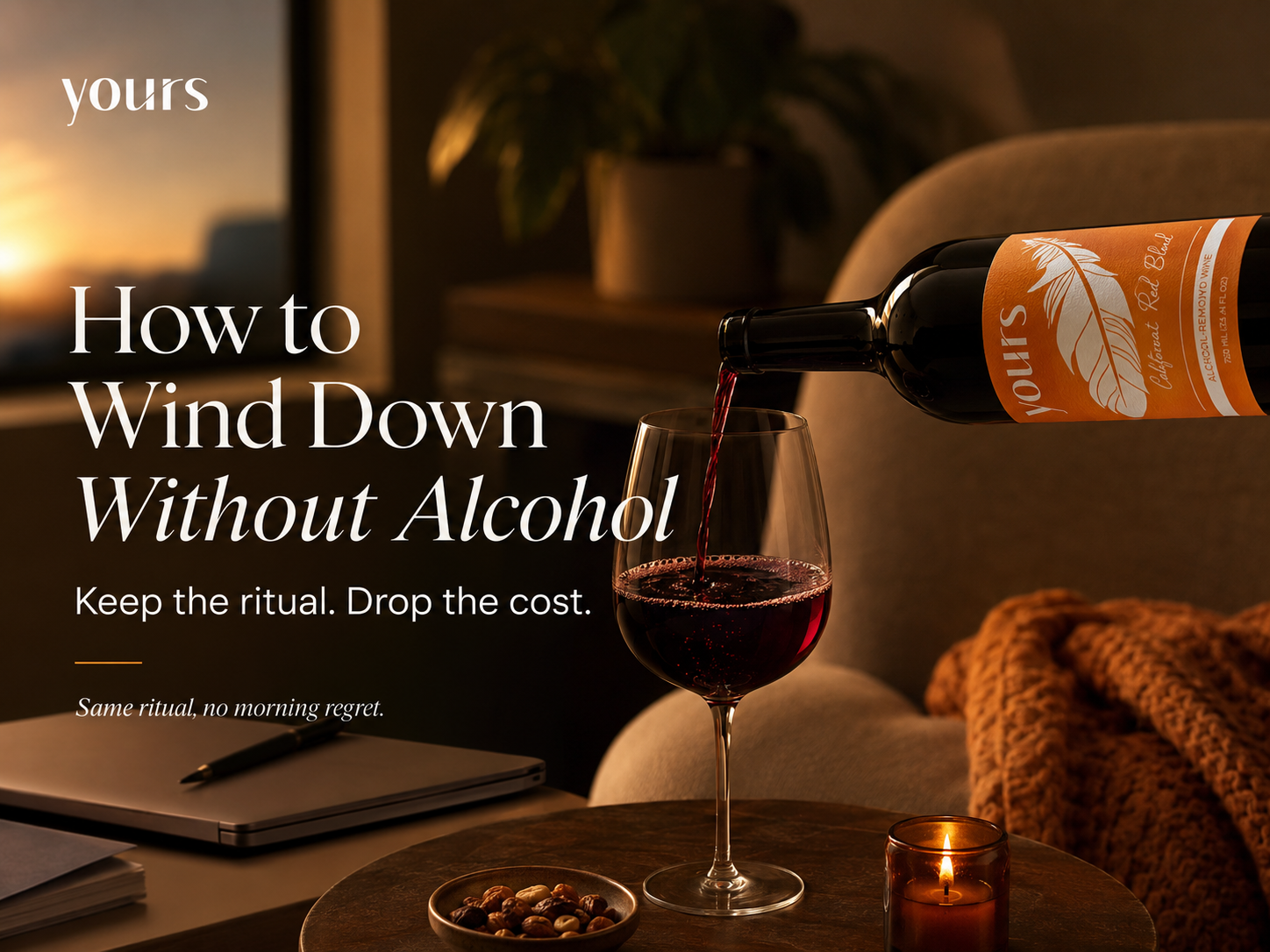
It's 6:15. The laptop closes. The day finally ends.

For years, the next twenty minutes have run the same way: the walk to the kitchen, the glass from the cabinet, the pour, the first sip, the exhale. Something in the body recognizes it. The mode shift happens. The day is done.
That ritual is not about alcohol. It never was. It's about a signal: something deliberate, sensory, and repeatable that tells the nervous system the workday is over and it can stand down. The glass is the mechanism. The pour is the cue. The exhale is the payoff.
The question more people are quietly asking isn't whether to keep the ritual. It's whether the ritual has to cost what regular wine costs to deliver. Because the part doing the heavy lifting in that end-of-day moment isn't the alcohol. It's everything else.

What the End-of-Day Glass Is Actually Doing
Here's what actually happens in those first ten minutes with a glass of wine .
You moved to a room that wasn't a desk. You stopped task-switching. You held something with weight and temperature and color. You smelled something complex. You did something intentional, just for yourself, with no deliverable attached.
Four distinct things happen at once:
The transition signal. The pour is a behavioral anchor. You've done it enough times that your nervous system reads it as a cue: mode shift, incoming. Researchers at Harvard (Brooks et al., 2016) found that small, intentional pre-performance rituals significantly reduce anxiety and improve focus, the same mechanism applies in reverse . The specific action matters less than the fact that it's consistent, sensory, and deliberate.
The sensory experience. Wine is a complex sensory object. The flavor, the glass, the temperature, the visual. Engaging multiple senses simultaneously in a single ritual is exactly what grounds the nervous system in the present moment. This is why aromatherapy works, why certain textures calm people, why the scent-to-emotion link is so powerful: sensory specificity creates presence. Presence is decompression.
The permission to stop. The ritual gives you social permission to stop working. You're not procrastinating. You're not being lazy. You're having a drink a culturally legible, recognized way to mark the transition from work mode to evening mode. That legitimacy is not trivial. It's part of what makes the signal work.
The identity confirmation. You're someone who has a proper drink at the end of a hard day. Not a sigh and a scroll through your phone. A glass. Something earned.
This is why "just try chamomile tea" fails for wine drinkers every time. It addresses none of the four. The signal is wrong. The sensory experience is flat. The identity confirmation is absent. The permission to stop doesn't arrive. The ritual doesn't fire.
What you need is not a replacement for wine. You need a version of the ritual that doesn't carry the costs that regular wine brings along with it.
The Psychology of the Decompression Ritual
Behavioral science has a precise name for what's happening in that end-of-day moment: the habit loop. The concept, extensively documented by researcher Charles Duhigg in The Power of Habit, maps three components: cue, routine, reward. The cue is the trigger, the laptop closing, the commute ending, walking through the front door. The routine is the behavior. The reward is the feeling of relief, transition, and earned rest.
What makes evening wine habitual is not that alcohol is addictive in moderate amounts. What makes it habitual is that the cue-routine-reward loop is well-trained, and it works.
A 2018 study in the Journal of Personality and Social Psychology found that people who engaged in ritualistic behavior before life transitions reported greater feelings of control and less anxiety about change. The consistency of the ritual is doing psychological work, it's not decoration, and it's not weakness. It's the nervous system using a reliable anchor to shift states.
The applied psychology literature on end-of-day rituals is consistent on one point: any behavior that signals the shift between work mode and evening mode helps facilitate the transition. A behavior analyst at Northeastern University put it plainly: "Rituals and behaviors signaling the end of the workday can facilitate the transition from having a job to having a life."
The ritual is the product. Not the chemical in the glass.
Where regular wine complicates this is by attaching a set of physiological costs to the ritual that arrive later, after the transition has already done its job.
What Regular Wine Takes From the Ritual
The end-of-day glass works for the first hour. The costs show up later.
Sleep architecture. Research on alcohol and sleep is consistent and unambiguous. A 2018 study by Pietilä et al. in JMIR Mental Health found that even low doses of alcohol, one drink, measurably altered heart rate variability during sleep, reducing the restorative quality of sleep by over 9%. Two drinks decreased recovery markers significantly further. The mechanism: alcohol suppresses REM sleep during the first half of the night. REM is where the brain consolidates memory, processes emotion, and does its overnight maintenance. You fall asleep faster with alcohol in your system, that part is real. But the sleep architecture is compromised. The 3am wake. The blunted feeling in the morning. That's not coincidence.
A 2024 systematic review and meta-analysis in Sleep Medicine Reviews confirmed the effect across healthy adults: alcohol consistently suppresses REM sleep in proportion to dose, with disruption persisting into the recovery phase as blood alcohol clears.
The cortisol rebound. Alcohol suppresses cortisol initially, that initial relaxation feeling is real. But the body compensates. As alcohol clears the bloodstream, cortisol rebounds above baseline. Research published in PMC on alcohol and the HPA axis shows that this rebound is part of the body's effort to restabilize after ethanol-mediated suppression of corticotropin-releasing hormone. The low-grade edginess the morning after a couple of glasses isn't psychological. It's the cortisol spike arriving while you sleep and persisting into the morning. For a full look at this mechanism, the piece on hangxiety and the next-day anxiety cost covers the research in detail.
The calorie math. A standard glass of regular wine runs 120 to 150 calories. Five nights a week, fifty-two weeks a year: 31,200 to 39,000 calories annually from a single ritual. That's 9 to 11 pounds of caloric surplus per year from one glass a night. Not a lecture. Just the math. The ritual has a cost, and for a growing number of people, that cost has started to outweigh the benefit.
What Makes a Wind-Down Ritual Work Without Alcohol
The research on behavioral transition rituals points to a consistent set of ingredients. Alcohol is not one of them.
Consistency beats intensity. The ritual works because the cue fires reliably, not because the behavior is dramatic. This means a consistent time, a consistent location, and a consistent sequence matters more than making each evening feel extraordinary. The nervous system learns from repetition. Cortisol levels drop naturally in the late afternoon; a consistent anchor at 6pm trains the body to associate that time with transition.
Sensory richness matters. The reason chamomile tea fails and non-alcoholic wine succeeds is not about the ingredients. It's about the sensory footprint. Wine, including dealcoholized wine made from real grapes, delivers complexity: aroma, color, mouthfeel, a specific kind of visual. That sensory specificity engages the limbic system, the same system tied to emotion and memory, and it's what makes the cue actually fire. A warm mug of herbal tea has a narrower sensory profile. It signals "sick" or "bedtime." The brain doesn't read it as a mode-shift cue.
Physical slowdown reinforces the signal. Sitting down matters. Not working while the ritual happens matters. A 2016 Harvard study found that pre-event rituals reduced anxiety specifically because they required focused, deliberate physical action, the opposite of distracted multitasking. The ritual only works when it has your attention. Pouring YOURS into a glass while standing over the sink checking email is not the same ritual as pouring it and sitting down.
Transition, not sedation. The goal of the evening ritual is to shift modes, from task-oriented, output-focused work-brain to present, ambient, evening-brain. Alcohol can sedate, but sedation is not the same as transition. The actual transition work is done by the deliberate behavioral signal. This is why people who switch to non-alcoholic wine often report that the ritual feels the same within a few weeks, even without the pharmacological layer.

YOURS in the Evening Ritual
YOURS works in the end-of-day ritual because it satisfies the four requirements the ritual actually has, not despite being non-alcoholic, but because of how it was built.
The signal. The bottle, the pour, the glass with color and legs. The act is indistinguishable from pouring regular wine. The nervous system gets the cue it's been trained on. The mode shift fires.
The sensory experience. YOURS is made from real California and Washington wine, dealcoholized using a process that preserves phenols, tannins, and flavor compounds. The mouthfeel is there. The complexity is there. The CA Cabernet Sauvignon delivers vanilla, cedar, and dark fruit. The WA Sauvignon Blanc brings bright acidity and citrus. The Rosé is dry, not sweet. The glass smells right. The sip lands right. For a full breakdown of how non-alcoholic wine is made and what the dealcoholization process actually preserves, that piece covers the production in detail.
The permission to stop. Pouring YOURS into a proper wine glass and sitting down with it sends the same cultural signal as regular wine. You're having a drink. The ritual is legible. No explanation required.
The identity. Not juice. Not a "mock" anything. A glass of wine made by California and Washington winemakers, from real grapes, using the same production process as the bottles next to it on the shelf. The only difference is what was removed at the end.
The calorie exchange is substantial: under 20 calories per glass, zero added sugar, no alcohol-driven disruption to sleep or morning cortisol. Five nights a week over a year: roughly 2,600 to 5,200 calories total, against the 31,200 to 39,000 from regular wine. The ritual costs nothing metabolically. The evening holds. The sleep improves. For more on the sleep mechanism specifically, the article on what alcohol does to your sleep covers exactly what changes.
Over 93% of NA wine buyers still also drink regular wine sometimes (NIQ, 2024). YOURS is not a commitment to a new identity. It's an option that keeps the ritual intact on the nights you want the experience without the cost. For anyone building a Dry January habit or looking to make the swap more permanent, the ritual mechanics described here transfer directly.
Other Options Worth Having
Non-alcoholic wine is not the only thing that works. The key is sensory richness and behavioral consistency, the specific substance matters less than whether it delivers a credible cue.
Sparkling water with something in it. A glass of sparkling water with a squeeze of citrus and a few drops of bitters has more sensory complexity than flat water. The carbonation adds texture. The bitters add depth. It doesn't replicate wine, it doesn't try to, but served in a proper glass, it delivers enough sensory signal to work as a transition cue for some people.
Kombucha. The slight effervescence and tangy complexity give kombucha a sensory profile closer to wine than most alternatives. Dry varieties, particularly those with lower residual sugar, can work effectively in a wine glass. For a direct comparison of how kombucha stacks up against non-alcoholic wine on sugar, polyphenols, and occasion fit, see non-alcoholic wine vs kombucha.
Adaptogenic drinks. A growing category of beverages built around ashwagandha, reishi, and L-theanine is designed specifically for decompression. The research on adaptogens is preliminary and mixed, don't over-index on the health claims, but the ritual format works when the product is served properly.
A deliberate non-drink ritual. For some people, the best version of the evening transition involves no glass at all. A short walk immediately after the workday, twenty minutes, same route, same time, functions as a powerful transition cue. The research on walking and cortisol reduction is strong. If the glass has become more obligation than pleasure, the walk may do more work.
Herbal tea, done right. Chamomile fails as a wine substitute. But if you treat herbal tea as its own ritual, same chair, same time, a specific tea you've chosen for the occasion, served in a proper cup, no phone for five minutes, it can work as a transition cue. The problem is almost never the tea. It's the lack of deliberateness.
None of these compete with each other. The ritual works when it's consistent and sensory. What fills the glass is secondary to whether you've made the moment intentional.

How to Build the Ritual Intentionally
The transition from regular wine to YOURS (or any alternative) works best when you treat the ritual as worth designing.
Temperature. YOURS Cabernet and red varietals: 60 to 65 degrees. White and Rosé: 45 to 50 degrees. Temperature affects aromatic release. Too cold and it's flat. Serve it right and the first smell is exactly what you expect.
Glassware. A real wine glass with a wide enough bowl to swirl. Not a tumbler. The shape concentrates the aromatics and signals to the brain that this is the ritual, not a stopgap.
The pour. Slow, same as always. Watch the color hit the glass. The visual is part of the sensory cue that fires the transition signal. You've done this enough times that the color landing in the glass is part of the mechanism.
Ninety seconds before the phone. After you pour, sit down. Don't check the phone. Don't open a new task. Give the ritual ninety seconds to work. Smell it. Take one sip. Breathe. The transition works when you let it work.
Consistent timing. The ritual is most effective at a consistent time every evening. The body's cortisol levels begin dropping naturally in the late afternoon. If you're building or re-anchoring a habit, 6pm is a solid default. Same time trains the cue faster.
Protect it from becoming ambient. The ritual loses its power when it becomes background noise. Pouring while standing over the sink half-checking email is not the same as pouring and sitting down. The deliberateness is the mechanism. Sitting is part of the ritual. So is doing nothing else for the first few minutes.
Frequently Asked Questions
Does non-alcoholic wine actually help you wind down?
Yes, though not through the same mechanism as regular wine. The decompression benefit from an end-of-day glass comes primarily from the ritual itself: the transition signal, the sensory experience, and the deliberate pause. Non-alcoholic wine that delivers those elements works as a behavioral cue for mode-shifting. The absence of alcohol also means no cortisol rebound and no REM sleep suppression, so the relaxation effect holds through the night rather than fragmenting at 2 or 3am.
What is the best substitute for wine ?
For wine drinkers specifically, non-alcoholic wine is the option that preserves the ritual intact. Herbal tea, sparkling water, and other common recommendations often fail because they don't deliver the sensory complexity or behavioral signal that makes the wine ritual work. The best substitute is one that fires the same cue, matches the sensory profile closely enough, and feels deliberate rather than like a compromise. See the best non-alcoholic wine for a full breakdown of what to look for when choosing.
Will I miss the alcohol buzz?
Honestly, for the first few nights, yes. What most people find after a week or two is that the transition feeling they were attributing to the alcohol was largely the ritual itself, the deliberate pause, the sensory shift, the permission to stop working. Once the ritual is re-anchored to a non-alcoholic option, the craving for the pharmacological layer diminishes. Sleep quality improving quickly also tends to recalibrate what "relaxed" actually feels like.
How long does it take to replace the wine habit with a non-alcoholic alternative?
Most people report the substitution feels natural within two to three weeks of consistent use. The behavioral anchor (the cue-routine-reward loop) transfers faster when the substitution is sensory-rich and the serving ritual is identical. Temperature, glassware, and the act of pouring deliberately all accelerate the transfer.
Can you drink non-alcoholic wine every night?
Yes. There is no physiological reason to moderate non-alcoholic wine the way you'd moderate regular wine. Under 20 calories per glass, zero added sugar, no alcohol-related health considerations. If you're pregnant or managing a specific medical condition, check with your doctor. For women navigating perimenopause or menopause who are also reconsidering alcohol's role in their evenings, alcohol and menopause covers how the two intersect specifically.
Does the ritual work without alcohol in the wine?
Research on behavioral transition rituals is consistent on this point: the content of the ritual matters less than its sensory specificity and consistency. The glass, the pour, the smell, the sip, the act of sitting down deliberately, these are doing the transition work. Alcohol adds a pharmacological layer, but the behavioral anchor transfers when the sensory signals are preserved. This is why sensory quality in the NA wine matters significantly: flat, sweet, or thin options fail because the sensory signal misfires and the cue doesn't fire correctly.
What if I still want regular wine sometimes?
Then have it. YOURS is not a statement about your relationship with wine. It's an option that keeps the ritual intact on the nights you want the experience without the cost. Over 93% of NA wine buyers still drink regular wine occasionally (NIQ, 2024). The point is that you have the choice. The ritual doesn't have to be all-or-nothing.
How is this different from just quitting alcohol?
This is not about quitting anything. It's about understanding what the ritual is actually doing and making sure it works as well as possible. Moderating, swapping in an NA option some nights, or keeping the whole routine exactly as-is are all valid. The only thing worth examining is whether the current version of the ritual is delivering what you want from it.
For the specific mechanism by which alcohol actually increases anxiety over time, including the GABA rebound and cortisol disruption that makes the end-of-day glass counterproductive for many people, see alcohol and anxiety.
Frequently Asked Questions
Does non-alcoholic wine actually help you wind down?
Yes, though not through the same mechanism as regular wine. The decompression benefit from an end-of-day glass comes primarily from the ritual itself: the transition signal, the sensory experience, and the deliberate pause. Non-alcoholic wine that delivers those elements works as a behavioral cue for mode-shifting. The absence of alcohol also means no cortisol rebound and no REM sleep suppression.
What is the best substitute for wine at the end of the day?
For wine drinkers specifically, non-alcoholic wine is the option that preserves the ritual intact. Herbal tea and sparkling water often fail because they don't deliver the sensory complexity or behavioral signal that makes the wine ritual work.
Will I miss the alcohol buzz?
Honestly, for the first few nights, yes. What most people find after a week or two is that the transition feeling they were attributing to the alcohol was largely the ritual itself. Once the ritual is re-anchored to a non-alcoholic option, the craving for the pharmacological layer diminishes significantly.
How long does it take to replace the wine habit with a non-alcoholic alternative?
Most people report the substitution feels natural within two to three weeks of consistent use. The behavioral anchor transfers faster when the substitution is sensory-rich and the serving ritual is identical.
Can you drink non-alcoholic wine every night?
Yes. There is no physiological reason to moderate non-alcoholic wine the way you'd moderate regular wine. Under 20 calories per glass, zero added sugar, no alcohol-related health considerations.
Does the ritual work without alcohol in the wine?
Research on behavioral transition rituals is consistent: the content of the ritual matters less than its sensory specificity and consistency. The glass, the pour, the smell, the sip, the act of sitting down deliberately — these are doing the transition work. The behavioral anchor transfers when the sensory signals are preserved.
What if I still want regular wine sometimes?
Then have it. YOURS is an option that keeps the ritual intact on the nights you want the experience without the cost. Over 93% of NA wine buyers still drink regular wine occasionally (NIQ, 2024).
How is this different from just quitting alcohol?
This is not about quitting anything. It's about understanding what the ritual is actually doing and making sure it works as well as possible. Moderating, swapping in an NA option some nights, or keeping the whole routine exactly as-is are all valid choices.
Related in this topic
- Non-Alcoholic Wine Health Guide (topic guide)
- Non-Alcoholic Wine for Weight Management: How a Glass a Day Can Help You Lose Weight
- What Alcohol Does to Your Sleep (And Why Non-Alcoholic Wine Doesn't)
- The Lowest Calorie Non-Alcoholic Wine (With Real Numbers)
- Non-Alcoholic Wine for Dry January: A Guide for People Who Actually Like Wine