Alcohol and Anxiety: Why Drinking to Relax Creates More Anxiety Over Time
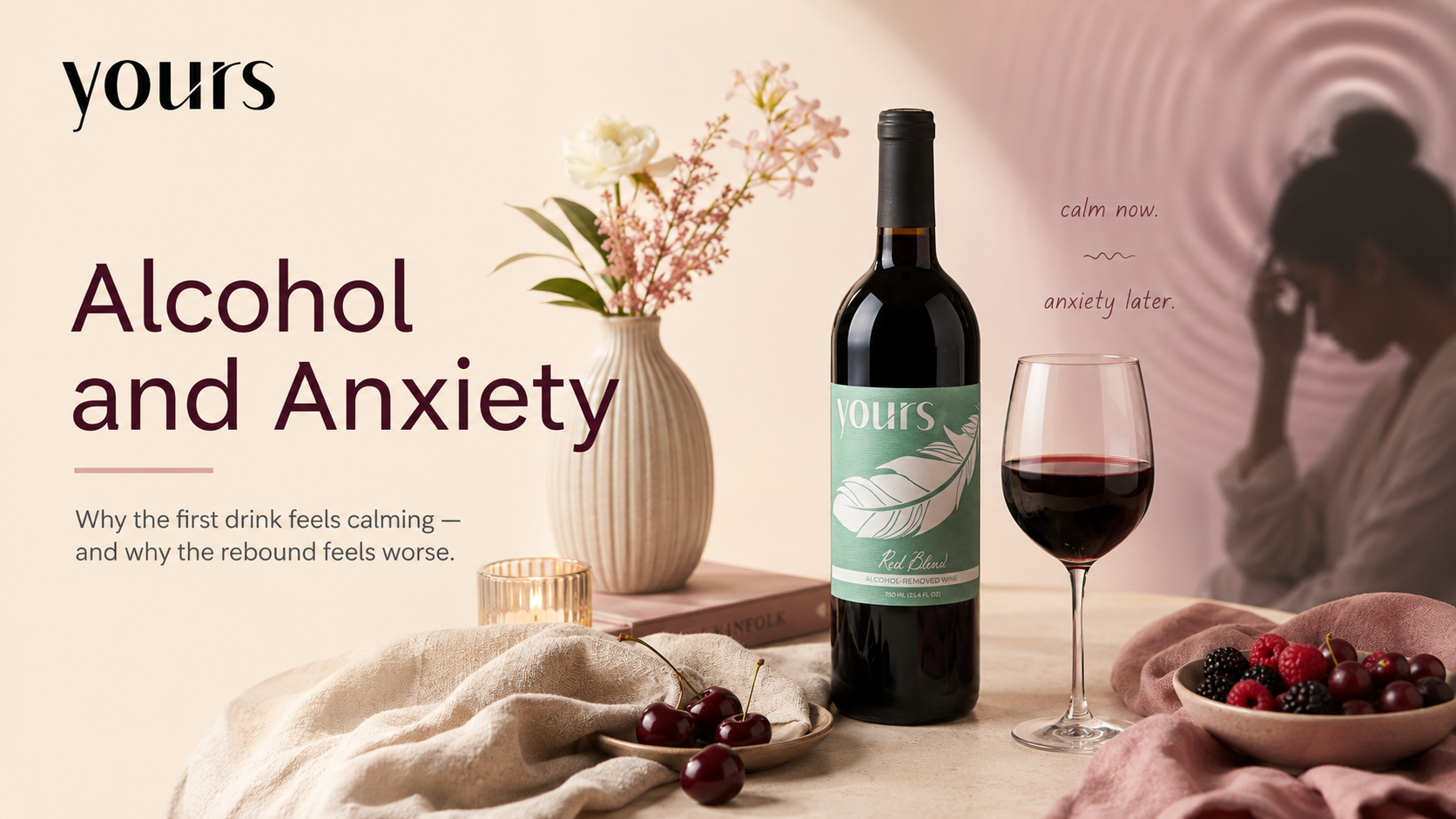
Alcohol causes anxiety through two mechanisms: GABA rebound, in which the nervous system overcompensates after alcohol clears and becomes more excitable than before, and cortisol elevation, in which the HPA stress axis is activated even during the calming phase. Both mechanisms operate at moderate consumption levels.

One drink takes the edge off. This is not imagination. The pharmacology is real, the mechanism is specific, and the relief is genuine.
The problem is what happens next.
Alcohol is one of the most effective short-term anxiolytics available without a prescription. It works the same way benzodiazepines work, through the same brain receptor system, producing genuine calm within minutes of the first drink. People who say they drink to manage anxiety are not rationalizing. They are describing an accurate self-experiment.
But the brain adapts. And the adaptation produces the opposite of what the alcohol was doing. Over time, and sometimes within hours of a single session, alcohol creates more anxiety than you started with.
This article explains exactly how that happens: the receptors involved, the compensation mechanism, the cortisol spike, the sleep disruption, and what happens to people who use alcohol to manage social anxiety long-term. The short answer is not a hopeful one for the strategy. The mechanism answer is important to understand regardless.
This is not medical advice. For any ongoing anxiety concerns, a healthcare provider is the right resource.
 The Short-Term Mechanism: Why One Drink Actually Works
To understand how alcohol creates anxiety, you first need to understand why it relieves it.
The brain's primary inhibitory neurotransmitter is GABA, gamma-aminobutyric acid. GABA's function is to reduce neural excitability. When GABA activity is high, the nervous system quiets. Stress responses dampen. The racing thoughts slow.
Alcohol is a positive allosteric modulator of GABA-A receptors. That is a technical way of saying it makes GABA more effective at its job. When alcohol binds to GABA-A receptors, it enhances the inhibitory signal. The result is reduced neural firing, lowered arousal, and the subjective experience of calm.
Simultaneously, alcohol inhibits NMDA glutamate receptors. Glutamate is the brain's primary excitatory neurotransmitter. Alcohol suppresses it. More GABA-equivalent activity plus less glutamate activity equals a significantly quieter nervous system.
This is the same dual mechanism used by benzodiazepines, which are pharmaceutical anxiolytics. Benzodiazepines also enhance GABA activity and suppress glutamate. This is not a coincidence, and it is not a matter of degree. The pharmacological principle is identical. The alcohol effect is simply broader, less precise, and accompanied by several additional mechanisms that create downstream problems.
The anxiolytic effect is real. The relief is real. And this is exactly the problem, because a real short-term benefit creates a plausible case for the strategy. People try it, it works, and they repeat it.
This is the data nobody talks about. According to NIQ (2024), 92% of non-alcoholic wine buyers also still buy alcoholic products. The people swapping in NA wine are not abstaining. They are moderating. They want the ritual without every glass adding up.
The Rebound: What the Brain Does While You're Relaxing
The human brain is a homeostatic system. It maintains its own equilibrium and resists perturbation in either direction. When something external shifts the balance, the brain compensates.
While alcohol is enhancing GABA activity, the brain interprets the enhanced inhibition as excessive and compensates by downregulating GABA receptor sensitivity and density. Simultaneously, it upregulates glutamate receptor activity to restore excitatory balance.
This is the neuroadaptive response. It develops remarkably fast, beginning within the first hour of drinking and persisting after the alcohol has cleared.
When the alcohol metabolizes, the compensation remains. GABA activity falls below its pre-drinking baseline. Glutamate, sensitized and upregulated, now has no counterweight. The nervous system overshoots into a hyperexcitable state.
The subjective experience of that hyperexcitability is anxiety, restlessness, and irritability. This is the GABA rebound: the brain's compensatory upregulation of excitatory activity produces a nervous system that is more anxious after drinking than it was before.
At low-to-moderate consumption, this is what drives the next-day hangxiety effect described separately in our hangxiety article. But the rebound also produces effects within the same evening: as blood alcohol concentration drops after the initial peak, some people notice a paradoxical increase in anxiety relative to their earlier calm. The relaxation was the GABA effect. The creeping unease on the way down is the compensation making itself felt.
Research has documented the GABA rebound mechanism clearly. A review published in Neuropsychopharmacology (Krystal et al., 2006) describes the glutamate system's role in ethanol withdrawal and rebound as a central contributor to anxiety states that follow alcohol consumption. The same mechanism that makes the first drink anxiolytic makes the descent and aftermath anxiogenic.
Cortisol: The Hormone Running the Opposite Direction
There is a second mechanism running in parallel, and it works against the GABA effect from the moment drinking begins.
Alcohol activates the HPA axis (hypothalamic-pituitary-adrenal axis) and elevates cortisol, the body's primary stress hormone, even at moderate doses. This happens simultaneously with the GABA calming effect, not after it.
Cortisol's effects are broadly activating: it raises heart rate, increases alertness, mobilizes energy stores, and primes the body for threat response. Cortisol is anxiogenic. In research on anxiety disorders, elevated cortisol is consistently associated with increased anxiety, heightened threat sensitivity, and difficulty returning to calm after a stressor.
Alcohol produces dose-dependent cortisol elevation in both social drinkers and problem drinkers. The effect is not limited to heavy use. The HPA axis activation that drives cortisol release also produces cardiovascular effects documented in the alcohol and blood pressure research.
The practical implication: even while GABA is producing acute anxiolytic effects, cortisol is simultaneously being elevated. The GABA effect dominates during peak blood alcohol concentration, which is why the first drink produces calm. But cortisol's effects are longer-lasting, and as blood alcohol drops, the cortisol signal remains.
This creates a time-shifted profile: acute calm, followed by a cortisol-driven anxiety window. The person who has two glasses at dinner and wakes at 3 a.m. with racing thoughts is experiencing, among other things, cortisol's extended influence after the GABA effect has faded.
Sleep Architecture and the Anxiety Amplifier
Sleep deprivation amplifies anxiety through a well-characterized mechanism involving the amygdala.
The amygdala is the brain's threat-detection center. In well-rested brains, the prefrontal cortex maintains regulatory control over amygdala activity, allowing it to assess threats proportionately and override reactive responses. Sleep deprivation reduces prefrontal cortex activity and increases amygdala reactivity, producing heightened emotional responses and a general upregulation of perceived threat.
Research on sleep deprivation and emotional reactivity (Yoo et al., Current Biology, 2007) demonstrated that sleep-deprived subjects showed a 60% increase in amygdala reactivity compared to well-rested controls in response to emotionally negative stimuli. The anxiety pathways were measurably more active with less sleep.
Alcohol disrupts sleep architecture, specifically in ways that reduce the restorative stages of sleep. The mechanism is detailed in the sleep article (what alcohol does to your sleep), but the core point here is that alcohol reduces REM sleep and slow-wave sleep, the stages associated with emotional processing and memory consolidation.
The result: alcohol fragments sleep in ways that leave the brain's emotional regulation systems under-resourced the following morning. The anxiety this produces is not about the alcohol itself at that point. It is about what the alcohol did to the night. But the effect is real, and it compounds the GABA rebound and cortisol effects already in play.
Social Anxiety: The Specific Case Where the Strategy Backfires Worst
Social anxiety is worth addressing directly because it is the most common reason people use alcohol anxiolytically in social settings.
The acute mechanism works in both directions here. Alcohol enhances GABA, reduces inhibition, and lowers the activation threshold for social engagement. For someone with social anxiety, a drink before a party reduces the physiological anxiety response enough to participate in a way that feels impossible without it. The strategy produces short-term results.
The long-term outcome is the opposite of what the strategy was designed to achieve. Research has found no population where regular alcohol use improved social anxiety outcomes over time.
Research on social anxiety and alcohol has established a consistent pattern. People with social anxiety disorder who drink to manage social situations show worsened social anxiety over time, at a rate that exceeds what would be expected from the anxiety disorder progressing on its own. The proposed mechanism is multi-part.
First, neuroadaptation: repeated GABA enhancement leads to receptor downregulation, so the same dose produces less anxiolytic effect, and the compensatory hyperexcitability during sober states increases baseline anxiety. The baseline social anxiety is literally higher than it was before the strategy started.
Second, the person never develops alternative coping resources. Social exposure, which is the primary mechanism by which social anxiety reduces through cognitive-behavioral treatment, requires experiencing the anxiety without the chemical relief. Alcohol prevents the learning that reduces social anxiety through natural exposure.
Third, a phenomenon called expectancy development: the person becomes psychologically reliant on the cue of alcohol to function in social settings. Without a drink available, anxiety spikes in anticipation. The anxiety has now spread to include anticipatory anxiety about having a drink available, beyond the original social anxiety itself.
A review published in Addictive Behaviors (Carrigan and Randall, 2003) summarized the evidence on alcohol use and social anxiety: the short-term relief is real, and the long-term consequence is worse social anxiety. The review found no evidence that alcohol use improved social anxiety over time in any studied population.

Regular Use and Sensitization: How the Baseline Shifts
The individual session rebound is a specific effect. Regular drinking produces a more structural change.
With repeated alcohol use, the neuroadaptive response described above becomes a persistent feature of the brain's resting state rather than a temporary compensation. GABA receptor density decreases. Glutamate receptor sensitivity remains elevated. The brain establishes a new set point that is calibrated to expect alcohol.
In this state, the person is not anxious because they drank. They are anxious because they haven't. The nervous system's baseline is now more excitable than it was before regular drinking began. Alcohol does not restore them to their original calm. It restores them to the new, alcohol-dependent normal.
This is why anxiety is one of the cardinal symptoms of alcohol withdrawal. It is not a side effect. It is the predictable result of removing an exogenous GABA enhancer from a nervous system that has downregulated its own GABA function in response.
For people who drink regularly and experience anxiety on days they don't drink, this mechanism is worth understanding. The anxiety during abstinence is not evidence that you need alcohol. It is evidence that your nervous system has adapted to alcohol's presence and is recalibrating without it.
The recalibration is temporary. But understanding what it is makes the experience less alarming and less likely to be misinterpreted as evidence for the original strategy.
What YOURS Does and Doesn't Do Here
YOURS contains 0.5% ABV per glass. This is the TTB regulatory threshold for "non-alcoholic" designation, the same standard applied to ripe orange juice. At this concentration, there is no meaningful GABA-A receptor engagement, no NMDA glutamate suppression, and no HPA axis activation through ethanol.
The mechanisms described in this article require blood alcohol concentrations that a 0.5% ABV beverage does not produce.
This matters because many people who drink to manage anxiety are not primarily seeking the alcohol. They are seeking the ritual, the pause, the glass in hand, the social cue that signals the day is done. The ritual element of wine is real and documented, and it operates independently of the pharmacological effect.
Holding a glass, pouring a drink, participating in the social context of wine service, these carry their own signaling function. They mark a transition. They indicate membership in a shared experience. For many people, a significant part of what they experience as "relief" from the first drink arrives before the alcohol does anything biologically, because the ritual itself is a conditioned relaxation signal.
NA wine preserves this completely. The glass, the pour, the color, the swirl, the company, all of it. What it does not preserve is the GABA mechanism that triggers the rebound.
For people who drink to manage anxiety, removing the alcohol does not remove the ritual. It removes the mechanism that creates more anxiety. That is a specific and honest claim. YOURS is not a treatment for anxiety. It does not "fix" anxiety. It removes something that reliably makes it worse over time, while keeping the parts of the drinking experience that are actually pleasant.
That is worth understanding for what it is.
See also: how YOURS is made, how to wind down without alcohol, alcohol and weight loss, drinking less without making it a thing, and alcohol and cancer risk for the long-term health context around acetaldehyde exposure.
Frequently Asked Questions
Does alcohol cause anxiety? Alcohol causes anxiety through two primary mechanisms: GABA rebound (the nervous system overcompensates after alcohol clears, producing a hyperexcitable state) and cortisol elevation (alcohol activates the HPA stress axis, producing lasting cortisol-driven anxiety after the acute GABA calming effect fades). Both mechanisms are well-documented and occur even at moderate consumption levels.
Why does alcohol make anxiety worse the next day? The acute anxiolytic effect of alcohol (from GABA enhancement) lasts only as long as blood alcohol concentration is elevated. As alcohol clears, the brain's compensatory downregulation of GABA activity and upregulation of glutamate activity produces a nervous system that is more excitable than it was before drinking. This GABA rebound is the primary driver of next-day anxiety. Sleep disruption from alcohol compounds the effect by reducing prefrontal cortex regulation of the amygdala.
Can alcohol help with anxiety? Alcohol produces genuine short-term anxiety reduction through GABA-A receptor enhancement and glutamate suppression. This is the same mechanism as benzodiazepines. The relief is real. The problem is that repeated use triggers neuroadaptation: GABA receptor density decreases and glutamate activity increases at baseline, so the person experiences more anxiety than before they started. The short-term strategy produces the opposite long-term outcome.
Why do I feel anxious when I stop drinking? If you drink regularly and feel anxious on days you don't drink, your nervous system has adapted to alcohol's presence by downregulating its own GABA production. Without the exogenous GABA enhancement from alcohol, your inhibitory system is under-resourced relative to your excitatory system. This is a form of neuroadaptive withdrawal. It is not evidence that you need alcohol. It is evidence that your brain is calibrating for a state it has come to expect.
How does social anxiety and alcohol interact? Alcohol reduces social anxiety acutely by lowering the threshold for social engagement through GABA enhancement. In the short term, this works. Long-term, people with social anxiety who drink to manage it show consistently worse social anxiety over time. The mechanism: neuroadaptation raises the anxiety baseline, the person never develops natural coping resources, and anticipatory anxiety spreads to include anxiety about having a drink available. Research has found no population where regular alcohol use improved social anxiety outcomes.
What does non-alcoholic wine do for anxiety? At 0.5% ABV, YOURS does not produce meaningful GABA-A receptor engagement. It does not have the acute anxiolytic effect of alcoholic wine. What it preserves is the ritual: the glass, the pour, the social participation, the signal that the workday is over. For many people, the ritual itself carries a significant portion of the psychological relief. Removing the alcohol removes the mechanism that creates rebound anxiety. It does not claim to treat anxiety.
Frequently Asked Questions
Does alcohol cause anxiety?
Alcohol causes anxiety through two primary mechanisms: GABA rebound (the nervous system overcompensates after alcohol clears, producing a hyperexcitable state) and cortisol elevation (alcohol activates the HPA stress axis, producing lasting cortisol-driven anxiety after the acute GABA calming effect fades). Both mechanisms are well-documented and occur even at moderate consumption levels.
Why does alcohol make anxiety worse the next day?
As alcohol clears, the brain's compensatory downregulation of GABA activity and upregulation of glutamate activity produces a nervous system that is more excitable than it was before drinking. This GABA rebound is the primary driver of next-day anxiety. Sleep disruption from alcohol compounds the effect by reducing prefrontal cortex regulation of the amygdala.
Can alcohol help with anxiety?
Alcohol produces genuine short-term anxiety reduction through GABA-A receptor enhancement and glutamate suppression, the same mechanism as benzodiazepines. The problem is that repeated use triggers neuroadaptation: GABA receptor density decreases and glutamate activity increases at baseline, producing more anxiety than before the strategy started.
Why do I feel anxious when I stop drinking?
Regular drinkers who feel anxious without alcohol have nervous systems that adapted to alcohol's presence by downregulating GABA production. Without the exogenous GABA enhancement, the inhibitory system is under-resourced relative to the excitatory system. This is neuroadaptive withdrawal, not evidence that alcohol is needed.
How does social anxiety and alcohol interact?
Alcohol reduces social anxiety acutely through GABA enhancement. Long-term, people with social anxiety who drink to manage it show consistently worse social anxiety. Neuroadaptation raises the anxiety baseline, the person never builds natural coping resources, and research has found no population where regular alcohol use improved social anxiety outcomes.
What does non-alcoholic wine do for anxiety?
At 0.5% ABV, YOURS Non-Alcoholic Wine does not produce meaningful GABA-A receptor engagement. It preserves the ritual of drinking: the glass, the pour, the social participation, without the mechanism that creates rebound anxiety. It does not treat anxiety.
Related in this topic
- Non-Alcoholic Wine Health Guide (topic guide)
- Non-Alcoholic Wine for Weight Management: How a Glass a Day Can Help You Lose Weight
- What Alcohol Does to Your Sleep (And Why Non-Alcoholic Wine Doesn't)
- The Lowest Calorie Non-Alcoholic Wine (With Real Numbers)
- Non-Alcoholic Wine for Dry January: A Guide for People Who Actually Like Wine