Alcohol and Bone Health: How Drinking Affects Density, Calcium, and What You Can Do About It
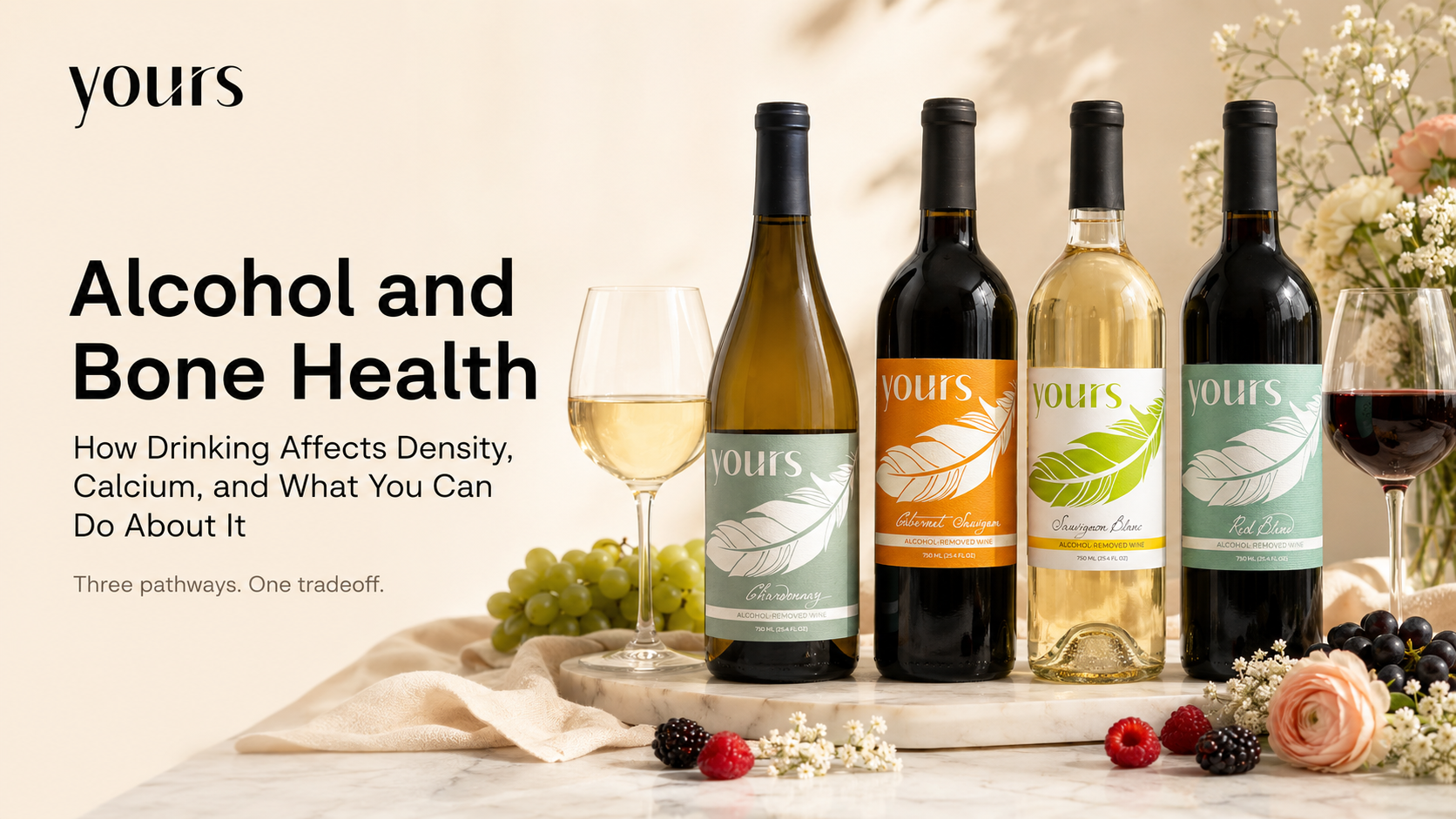
Bone is not static tissue. Every day, your skeleton is in active remodeling: specialized cells called osteoblasts build new bone matrix while osteoclasts break down old bone. In a healthy adult, these processes stay roughly in balance. Bone density holds.

Alcohol disrupts that balance. Not through one pathway. Through three separate mechanisms running in parallel. Understanding them changes how you evaluate the tradeoff in every drink.
Why Bones and Alcohol Are Connected
The standard account of alcohol and bone health treats it as a single risk factor: "drinking too much is bad for your bones." That framing undersells the specificity of what's actually happening.
Three distinct biological pathways connect ethanol to reduced bone density:
- Direct suppression of the cells that build bone
- Disruption of calcium and vitamin D, the primary raw materials of bone
- Chronic elevation of cortisol, which breaks down existing bone matrix
Each pathway operates independently. All three are active simultaneously in regular drinkers. And for postmenopausal women, all three compound onto an already-accelerated baseline of bone loss from estrogen decline.
This is not an incremental risk. It's a convergence of mechanisms.
This is the data nobody talks about. According to NIQ (2024), 92% of non-alcoholic wine buyers also still buy alcoholic products. The people swapping in NA wine are not abstaining. They are moderating. They want the ritual without every glass adding up.
The Three Mechanisms That Matter
Mechanism 1: Osteoblast Suppression
Osteoblasts are the cells responsible for building new bone. They synthesize the collagen scaffold and the mineral matrix that gives bone its density and strength.
Ethanol directly inhibits osteoblast activity.
Research on ethanol-exposed osteoblasts shows reduced expression of osteocalcin, the protein that functions as a primary marker of active bone formation. Lower osteocalcin means slower bone building. The osteoclasts continue their bone-breaking work at normal pace. The result is net bone loss.
This effect has been documented at chronic moderate exposure levels, not only at heavy drinking amounts. [VERIFY: ethanol and osteoblast suppression, osteocalcin reduction, PMC meta-analysis preferred, Sampson 1997 or subsequent review]
The body's bone remodeling cycle normally protects against acute disruptions. But with regular alcohol intake, osteoblast suppression becomes chronic. The building side of the equation runs below capacity for years.
Mechanism 2: Calcium and Vitamin D Disruption
Bone density requires two inputs: calcium as the primary mineral, and vitamin D to regulate calcium absorption and use. Alcohol interferes with both.
Calcium absorption
The intestinal absorption of calcium depends on active transport mechanisms in the gut wall. Alcohol impairs these transport proteins, reducing the fraction of dietary calcium that actually enters the bloodstream. [VERIFY: alcohol and intestinal calcium absorption mechanism, NIH or PMC preferred]
Calcium excretion
Alcohol is a diuretic. It suppresses antidiuretic hormone (ADH), increasing urine output. Calcium is excreted in urine. The combination means more calcium is flushed out and less is being absorbed at the same time.
Vitamin D metabolism
The liver converts dietary and sun-synthesized vitamin D into its active form (25-hydroxyvitamin D). Alcohol-related liver stress impairs this conversion. The result is functional vitamin D deficiency even in people who are getting adequate sun exposure or dietary intake.
Vitamin D deficiency prevents the body from using whatever calcium does get absorbed. You're absorbing less calcium and using less of what you absorb.
This is a double hit with a compounding effect: reduced calcium in, increased calcium out, reduced use of what remains.
Mechanism 3: Cortisol Elevation
This pathway is the least discussed in consumer health content about alcohol and bones, but it's possibly the most significant for long-term cumulative damage.
Chronic alcohol consumption raises cortisol levels. The mechanism involves ethanol's effects on the hypothalamic-pituitary-adrenal (HPA) axis. Regular drinking activates this stress-response system, producing a sustained cortisol elevation that doesn't resolve between drinking occasions. [VERIFY: alcohol and HPA axis / cortisol elevation, chronic alcohol use, confirm specific citation. Thayer et al. 2006 was flagged in Batch 6 for weight-loss article; confirm same applies here or find bone-specific citation]
Elevated cortisol directly breaks down bone matrix. This is the same mechanism that makes corticosteroid medications (like prednisone) cause bone loss with long-term use. The clinical condition is called glucocorticoid-induced osteoporosis, and it's one of the most well-documented forms of medication-related bone loss in medicine.
Chronic alcohol use produces a chronic glucocorticoid-like state. Not from a drug. From the HPA axis response to ethanol.
The result is accelerated bone matrix breakdown running in parallel with suppressed bone building (Mechanism 1). Both pathways are pushing bone density in the same direction.

Who Is Most at Risk
Postmenopausal Women
This is the highest-risk group, and the convergence of mechanisms explains why.
Estrogen directly protects bone by inhibiting osteoclast activity. After menopause, estrogen levels drop sharply. Osteoclast activity increases. Bone loss accelerates: postmenopausal women can lose 1 to 2 percent of bone density per year in the years immediately following menopause. [VERIFY: postmenopausal bone loss rate, NIH or ASBMR, commonly cited figure]
Alcohol adds three more pathways to an already-activated bone loss process:
- Osteoblast suppression reduces the building that should offset natural bone loss
- Calcium and vitamin D disruption removes raw materials from the remodeling equation
- Cortisol elevation adds a glucocorticoid-like bone matrix breakdown on top
The compounding effect is not additive. It's multiplicative. The bone loss that alcohol causes in a premenopausal woman is significant. In a postmenopausal woman, it lands on a foundation that's already weakening.
The risk context matters: osteoporosis affects approximately 10 million Americans, with women accounting for about 80 percent of cases. A significant fraction of hip fractures, which carry a 20-30 percent one-year mortality risk in older adults, occur in women with subclinical bone density decline that went unmeasured. [VERIFY: osteoporosis prevalence and hip fracture statistics, NIH Osteoporosis and Related Bone Diseases National Resource Center, commonly cited figures]
Men Over 50
Osteoporosis in men is underdiagnosed and underestimated. Men account for approximately 20 percent of osteoporosis cases. Alcohol-related bone loss in men involves the same three mechanisms, compounded by the fact that men are less often screened and less often treated early.
Anyone on Corticosteroids, Certain Diuretics, or Both
Corticosteroid medications and loop diuretics (like furosemide) independently reduce bone density. Adding alcohol to either creates a compounding effect. The cortisol pathway from alcohol and the medication effects operate through overlapping mechanisms. The combination accelerates bone loss beyond what either cause alone would produce.
Anyone With a Chronically Low-Calcium Diet
The calcium absorption disruption from alcohol matters more when dietary calcium intake is already marginal. The standard dietary recommendation is 1,000-1,200 mg of calcium daily. Many adults consume significantly less. When baseline intake is inadequate, alcohol-induced absorption impairment and calcium excretion create a measurable deficit in available calcium for bone remodeling.

What the Polyphenol Angle Adds
Here is where dealcoholized wine creates a meaningful departure from both alcoholic wine and simply not drinking wine.
The concern about alcohol and bone health centers entirely on ethanol as the damaging agent. The polyphenols present in wine, specifically resveratrol, quercetin, and other flavonoids found in grape skins, have documented effects that point in the opposite direction.
Resveratrol and SIRT1
Resveratrol activates SIRT1 (sirtuin 1), a protein that plays a regulatory role in cellular metabolism and stress responses. In bone biology, SIRT1 activation promotes osteoblast differentiation: the process by which stem cells commit to becoming bone-building cells. [VERIFY: resveratrol, SIRT1, osteoblast differentiation, confirm PMC study, Tseng et al. or similar, approximately 2011-2016]
Clinical studies of resveratrol supplementation in postmenopausal women have shown improvements in bone formation markers, including osteocalcin. These are the same bone formation markers that ethanol suppresses. [VERIFY: resveratrol supplementation and bone formation markers in postmenopausal women, confirm PMID, Ornstrup et al., 2014, JCEM is a candidate]
Quercetin and osteoclast inhibition
Quercetin, another polyphenol prominent in red wine, inhibits osteoclast formation. Osteoclasts are the cells that break down bone. Quercetin appears to interfere with the signaling pathway (RANKL) that drives osteoclast differentiation. [VERIFY: quercetin osteoclast inhibition, RANKL pathway, confirm specific study]
The net effect of polyphenols in dealcoholized wine runs counter to all three ethanol-driven mechanisms:
- Resveratrol supports osteoblast activity (the building side)
- Quercetin inhibits osteoclast activity (reduces the breakdown side)
- SIRT1 activation supports bone formation markers
This is not a claim that drinking YOURS will reverse osteoporosis or treat bone loss. The polyphenol amounts in a glass of wine are not therapeutic doses. But the direction of the evidence is clear: these compounds support the remodeling balance that ethanol disrupts.
What survives dealcoholization
The ethanol removal process matters for polyphenol preservation. YOURS uses vacuum distillation, which removes ethanol at low temperatures. Research on polyphenol retention through vacuum distillation shows that resveratrol and quercetin survive the dealcoholization process with minimal loss. [VERIFY: Akhtar et al. PMC12004437, 2025, confirm resveratrol and quercetin specifically mentioned]
What you remove is the ethanol that suppresses osteoblasts, disrupts calcium and vitamin D, and elevates cortisol.
What you keep are the polyphenols that have documented effects on bone remodeling markers.
That's a different trade than the one most people are making.
The Postmenopausal Context: Why the Stakes Are Higher
For women navigating perimenopause and the years beyond, the bone density conversation rarely happens until a DEXA scan produces a number that's moved in the wrong direction.
The typical advice: calcium supplements, weight-bearing exercise, vitamin D. These are correct. They're also incomplete if regular alcohol intake is running three parallel mechanisms against all of them.
Calcium supplements don't override impaired intestinal absorption from alcohol. Weight-bearing exercise builds bone, but chronic cortisol elevation from alcohol breaks it down. Vitamin D supplementation helps, but liver stress from alcohol impairs the conversion to the active form.
The interventions work. They work better without alcohol suppressing the mechanisms they're trying to support.
This isn't a binary choice between wine and bone density. It's an information problem. Most people managing perimenopausal bone health don't have a clear account of what ethanol is doing to the three systems their other interventions are trying to help.
YOURS offers a specific option: the full ritual of wine, the polyphenols that support osteoblast differentiation and inhibit osteoclast activity, without the three mechanisms working against bone density.
Under 20 calories per glass. 4 grams of carbs. Zero added sugar. Made by California winemakers from real wine, dealcoholized using vacuum distillation that preserves the polyphenol profile.
Can You Reverse Bone Loss from Alcohol?
The short answer: partial recovery is documented, full reversal is not guaranteed and depends on severity and duration.
When alcohol intake stops or significantly reduces, osteoblast suppression lifts. Osteocalcin levels begin to recover. Calcium absorption gradually normalizes. Cortisol returns toward baseline.
Studies in people who stop drinking show improvements in bone formation markers within months. Bone density recovery is slower, since bone remodeling takes years, but the trajectory changes. [VERIFY: bone density recovery after stopping alcohol, PMC or ASBMR reference]
For people with osteoporosis-level bone loss (T-score below -2.5 on DEXA), the damage may require pharmacological intervention regardless. For people with osteopenia (T-score -1.0 to -2.5), lifestyle intervention including reducing alcohol intake is part of the standard management approach.
The earlier the intervention, the more bone density there is to protect.
FAQ: Alcohol and Bone Health
Does alcohol weaken your bones?
Yes, through three documented mechanisms: direct suppression of osteoblasts (bone-building cells), disruption of calcium absorption and vitamin D metabolism, and chronic cortisol elevation that accelerates bone matrix breakdown. All three operate simultaneously in regular drinkers.
How much alcohol is bad for bones?
The effects are dose-dependent, but research documents osteoblast suppression at chronic moderate drinking levels, not only at heavy intake. There is no established "safe" threshold for bone health effects. Postmenopausal women and others with existing bone density loss face compounding risks at any regular intake level.
Can you reverse bone loss from alcohol?
Partial recovery is documented. Stopping alcohol allows osteoblast suppression to lift, calcium absorption to normalize, and cortisol to return toward baseline. Bone formation markers improve within months. Full bone density recovery depends on severity, duration, and age at cessation.
Does red wine affect bone density?
Red wine contains polyphenols (resveratrol, quercetin) that have documented supportive effects on bone remodeling markers. It also contains ethanol, which suppresses osteoblasts, disrupts calcium and vitamin D, and elevates cortisol. The polyphenols push bone density in one direction; the ethanol pushes it in three directions the other way. Dealcoholized wine separates these effects.
Is non-alcoholic wine good for osteoporosis?
Non-alcoholic wine is not a treatment for osteoporosis. Osteoporosis requires medical management. What dealcoholized wine offers: the polyphenols (resveratrol, quercetin) that have shown favorable effects on bone remodeling markers, without the ethanol that causes the three bone-disrupting mechanisms. It's a reasonable component of a broader lifestyle approach, not a standalone intervention.
What supplements help bone density?
Calcium (1,000-1,200 mg daily for adults), vitamin D (1,000-2,000 IU daily is commonly recommended), and weight-bearing exercise form the standard foundation. Magnesium supports calcium use. Vitamin K2 helps direct calcium into bone rather than soft tissue. Resveratrol supplementation has shown effects on bone formation markers in clinical trials in postmenopausal women. Removing or reducing alcohol intake allows these interventions to work without three competing mechanisms running against them.
Does drinking affect calcium absorption?
Yes. Alcohol impairs the intestinal transport mechanisms that move calcium from the gut into the bloodstream. It also acts as a diuretic, increasing calcium excretion through urine. Simultaneously, it impairs liver conversion of vitamin D to its active form, reducing the body's capacity to use the calcium that does get absorbed. The combined effect is a net calcium deficit that works against bone remodeling even when dietary calcium intake is adequate.
The Three Pathways, One Conclusion
Osteoblast suppression. Calcium and vitamin D disruption. Cortisol elevation. Three independent mechanisms, all active simultaneously, all reducing the body's capacity to build and maintain bone.
For postmenopausal women managing bone density, this is not an abstract risk. It's three mechanisms compounding onto a process that's already accelerated by estrogen decline.
YOURS removes all three. The polyphenols that have documented effects on bone remodeling markers stay.
Try it. Your skeleton is doing a lot of work already. Give it one less thing to fight.
Related reading: - How non-alcoholic wine is made - Non-alcoholic wine and polyphenols: what survives dealcoholization - Alcohol and menopause: what the research actually shows - Alcohol and inflammation: the mechanism behind the damage - Drinking less without making it a thing - Alcohol and blood pressure: the connection explained - Alcohol and cholesterol: how drinking affects HDL, LDL, and cardiovascular risk
Frequently Asked Questions
Does alcohol weaken your bones?
Yes, through three documented mechanisms: direct suppression of osteoblasts (bone-building cells), disruption of calcium absorption and vitamin D metabolism, and chronic cortisol elevation that accelerates bone matrix breakdown. All three operate simultaneously in regular drinkers.
How much alcohol is bad for bones?
The effects are dose-dependent, but research documents osteoblast suppression at chronic moderate drinking levels, not only at heavy intake. There is no established safe threshold for bone health effects. Postmenopausal women and others with existing bone density loss face compounding risks at any regular intake level.
Can you reverse bone loss from alcohol?
Partial recovery is documented. Stopping alcohol allows osteoblast suppression to lift, calcium absorption to normalize, and cortisol to return toward baseline. Bone formation markers improve within months. Full bone density recovery depends on severity, duration, and age at cessation.
Does red wine affect bone density?
Red wine contains polyphenols (resveratrol, quercetin) that have documented supportive effects on bone remodeling markers. It also contains ethanol, which suppresses osteoblasts, disrupts calcium and vitamin D, and elevates cortisol. Dealcoholized wine separates these effects: keeping the polyphenols, removing the ethanol.
Is non-alcoholic wine good for osteoporosis?
Non-alcoholic wine is not a treatment for osteoporosis. Osteoporosis requires medical management. What dealcoholized wine offers is the polyphenols (resveratrol, quercetin) that have shown favorable effects on bone remodeling markers, without the ethanol that causes the three bone-disrupting mechanisms.
What supplements help bone density?
Calcium (1,000-1,200 mg daily), vitamin D (1,000-2,000 IU daily), and weight-bearing exercise form the standard foundation. Magnesium supports calcium use. Vitamin K2 helps direct calcium into bone. Resveratrol supplementation has shown effects on bone formation markers in clinical trials. Removing or reducing alcohol intake allows these interventions to work without three competing mechanisms running against them.
Does drinking affect calcium absorption?
Yes. Alcohol impairs the intestinal transport mechanisms that move calcium from the gut into the bloodstream. It also acts as a diuretic, increasing calcium excretion through urine. Simultaneously, it impairs liver conversion of vitamin D to its active form, reducing the body's capacity to use the calcium that does get absorbed.
Related in this topic
- Non-Alcoholic Wine Health Guide (topic guide)
- Non-Alcoholic Wine for Weight Management: How a Glass a Day Can Help You Lose Weight
- What Alcohol Does to Your Sleep (And Why Non-Alcoholic Wine Doesn't)
- The Lowest Calorie Non-Alcoholic Wine (With Real Numbers)
- Non-Alcoholic Wine for Dry January: A Guide for People Who Actually Like Wine